
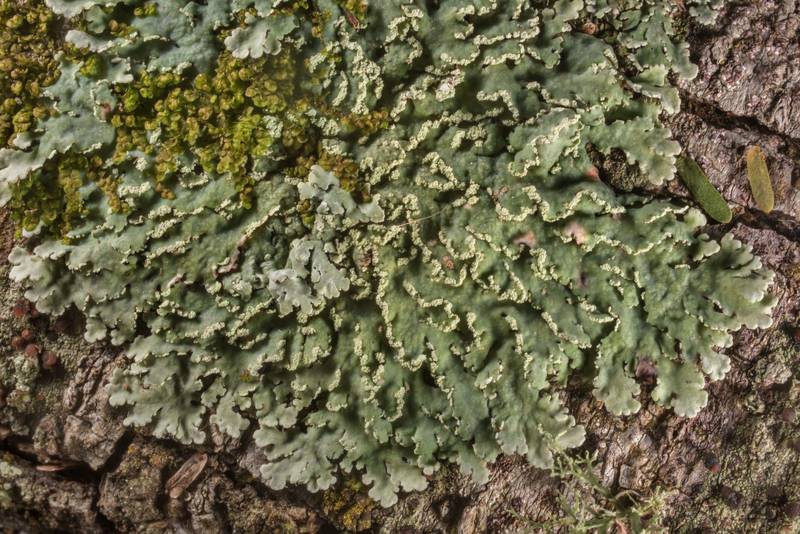
White fringe lichen (Heterodermia albicans) and liverwort on a branch of an old Huisache (acacia) bush in Washington-on-the-Brazos State Historic Site. Washington, Texas


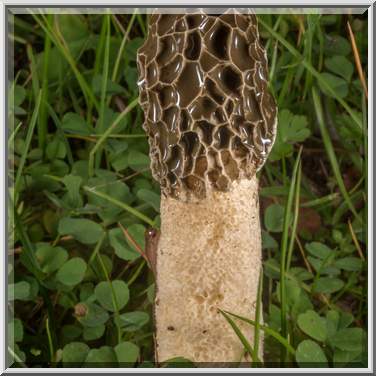
Album 2620: Mushrooms in Washington-on-the-Brazos Park, Texas, December 28, 2019
The image showcases two species of lichens growing on the surface of a branch from an old Huisache (acacia) bush at Washington-on-the-Brazos State Historic Site. The upper section features white fringe lichen (Heterodermia albicans), characterized by its distinctively irregular, scalloped appearance and greenish coloration. This lichen type is commonly found on decaying wood in many different habitats.
In contrast, the lower portion of the image displays a liverwort species, distinguished by its smaller size and more delicate growth pattern compared to the lichen above it. The liverwort's flat thallus is attached to the branch via rhizoids that have grown into the bark, while its leaves are typically arranged in a single layer on the upper surface of the thallus.
The branch itself exhibits signs of aging, with visible cracks and rough texture indicative of its old age. The overall scene presents a striking example of these two lichen species coexisting on a decaying tree limb, showcasing their unique characteristics and habitats within this specific ecosystem. – AI vision
🇪🇸 Descripción en español / Spanish Description
El líquen franjado blanco (Heterodermia albicans) y la hepáticas en una rama de un viejo arbusto Huisache (acacia) en el Washington-on-the-Brazos State Historic Site. Washington, Texas, 28 de diciembre de 2019. La imagen muestra dos especies de líquenes creciendo sobre la superficie de una rama de un viejo arbusto Huisache (acacia) en el Washington-on-the-Brazos State Historic Site. En la parte superior se encuentra el líquen franjado blanco (Heterodermia albicans), caracterizado por su aspecto ondulado irregular y distintivo, así como por su coloración verdosa. Este tipo de líquenes suele crecer en madera en descomposición en muchos hábitats diferentes. En contraste, la parte inferior de la imagen presenta una especie de hepáticas, distinguible por su menor tamaño y patrón de crecimiento más delicado en comparación con el líquen situado encima. El talo plano del hepático se une a la rama mediante rizoides que han crecido dentro de la corteza, mientras que sus hojas suelen disponerse en una única capa sobre la superficie superior del talo. La propia rama presenta señales de envejecimiento, con grietas visibles y una textura rugosa que indican su antigüedad. La escena global presenta un ejemplo destacable de estas dos especies de líquenes conviviendo sobre un brazo de un árbol en descomposición, mostrando sus características únicas y hábitats dentro de este ecosistema específico. – Spanish translation


