
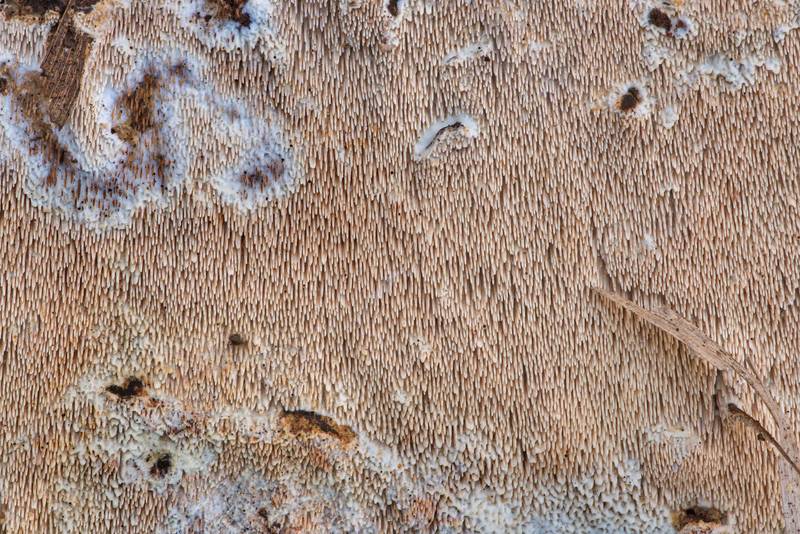

Close-up of hydnoid (tooth) fungus on a fallen oak in Lick Creek ParkLick Creek: Background Notes. College Station, Texas


Album 2625: Washington - College Station, Texas, January 5 - 8, 2020
The image shows a close-up view of a fallen oak tree trunk, covered with a type of fungus known as hydnoid or tooth fungi. The primary subject of the photograph is the fungal growth on the surface of the decaying wood.
**Fungal Growth**
* **Hydnoid Fungi**: The fungus appears to have grown in irregular patches across the surface of the tree trunk.
* **Texture and Color**: The fungus has a distinctive texture, resembling tiny teeth or spikes. It forms small clusters around the base of some larger growths on the wood.
* **Coloration**: The fungus is light brown in color and blends well with the surrounding wood.
**Tree Trunk**
* **Decaying Wood**: The tree trunk appears to be decaying rapidly, with visible cracks and grooves in its surface. This suggests that it has been dead for some time and is now being broken down by fungi.
* **Texture and Color**: The texture of the wood is rough and uneven, while the color ranges from light brown to grayish-brown.
**Background**
* **Lack of Background**: There is no background visible in the image. The photograph focuses solely on the fungus growing on the fallen oak tree trunk.
In summary, the image shows a close-up view of a fallen oak tree trunk covered with hydnoid or tooth fungi. The fungus has grown in irregular patches across the surface of the decaying wood and blends well with its surroundings due to its light brown coloration. – AI vision
🇪🇸 Descripción en español / Spanish Description
Un primer plano del hongo hídonido (diente) en un roble caído en el Lick Creek Park. College Station, Texas, 7 de enero del 2020. La imagen muestra una vista detallada de un tronco de roble caído, cubierto con un tipo de hongo conocido como hídonido o hongos de dientes. El sujeto principal de la fotografía es el crecimiento fúngico en la superficie del madera podrida. **Crecimiento Fúngico** * **Hongos Hídonidos**: parece haber crecido el hongo en parches irregulares a través de la superficie del tronco del árbol. * **Textura y Color**: El hongo tiene una textura distintiva, pareciéndose a dientes o picos pequeños. Forma pequeñas agrupaciones alrededor de la base de algunos crecimientos más grandes en la madera. * **Coloración**: el hongo es de color marrón claro y se combina bien con la madera circundante. **Tronco del Árbol** * **Madera Podrida**: parece que el tronco del árbol está podriéndose rápidamente, con grietas y surcos visibles en su superficie. Esto sugiere que ha estado muerto durante un tiempo y ahora está siendo degradado por hongos. * **Textura y Color**: la textura de la madera es rugosa e irregular, mientras que el color oscila entre marrón claro y marrón grisáceo. **Fondo** * **Falta de Fondo**: No hay fondo visible en la imagen. La fotografía se centra únicamente en los hongos que crecen en el tronco del roble caído. En resumen, la imagen muestra un primer plano del tronco de un roble caído cubierto con hongos hídonidos. El hongo ha crecido en parches irregulares a través de la superficie de la madera podrida y se mezcla bien con los alrededores debido a su coloración marrón claro. – Spanish translation


