
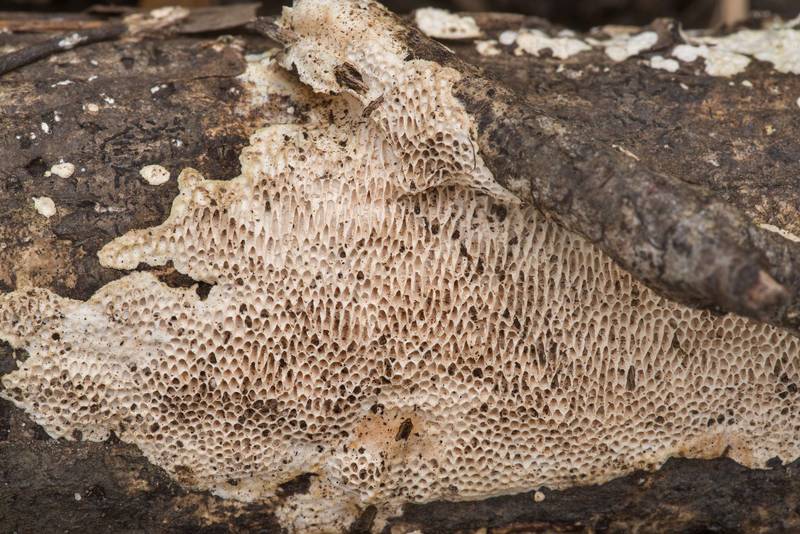

Resupinate polypore mushroom Megasporoporia setulosa (Dichomitus setulosus) or may be Datronia mollis on a fallen branch on Caney Creek section of Lone Star Hiking Trail in Sam Houston National Forest north from Montgomery. Texas


Album 2637: College Station - Sam Houston Forest, Texas, January 23 - 25, 2020
The provided image is a close-up photograph of a Resupinate polypore mushroom Megasporoporia setulosa or may be Datronia mollis growing on a fallen branch.
**Image Description**
* The image showcases the underside of the fungus, characterized by its resupinate growth habit.
* A large mass of white, honeycomb-like tissue is visible, which is typical for polypore mushrooms.
* The tissue is arranged in a regular pattern of hexagonal cells, giving it a honeycomb appearance.
* Some areas of the mushroom appear to be decaying or rotting, with brownish discoloration and softening of the tissue.
**Background and Context**
* The background of the image shows a dark-colored log or branch that the fungus is growing on.
* The overall atmosphere suggests that the photo was taken in a forested area, possibly during winter months given the mention of January 25th in the caption.
**Overall Impression**
The image provides a detailed view of the Resupinate polypore mushroom Megasporoporia setulosa or may be Datronia mollis growing on a fallen branch. The honeycomb-like tissue and decaying areas suggest that the fungus is likely saprotrophic, breaking down dead organic matter to obtain nutrients. – AI vision
🇪🇸 Descripción en español / Spanish Description
El hongo Resupinate polypore Megasporoporia setulosa (Dichomitus setulosus) o Datronia mollis en una rama caída del tramo de Caney Creek del Lone Star Hiking Trail en el bosque nacional Sam Houston al norte de Montgomery, Texas, el 25 de enero de 2020. La imagen proporcionada es una fotografía detallada de un hongo Resupinate polypore Megasporoporia setulosa o Datronia mollis creciendo en una rama caída. **Descripción de la Imagen** *La imagen muestra el lado inferior del hongo, caracterizado por su hábito de crecimiento resupinado. *Una gran masa de tejido blanco, similar a un panal, es visible, lo que es típico para los hongos poliporos. *El tejido está dispuesto en un patrón regular de células hexagonales, dando al hongo una apariencia de panal. *Algunas áreas del hongo parecen estar en proceso de descomposición o putrefacción, con decoloración pardusca y ablandamiento del tejido. **Antecedentes y Contexto** *En el fondo de la imagen se puede ver un tronco oscuro o una rama sobre la que crece el hongo. *El ambiente general sugiere que la fotografía fue tomada en una zona boscosa, posiblemente durante los meses de invierno dado el mencionado 25 de enero en la leyenda. **Impresión General** La imagen proporciona una vista detallada del hongo Resupinate polypore Megasporoporia setulosa o Datronia mollis creciendo en una rama caída. El tejido parecido a un panal y las áreas de descomposición sugieren que el hongo es probablemente saprotrofo, que rompe materia orgánica muerta para obtener nutrientes. – Spanish translation


