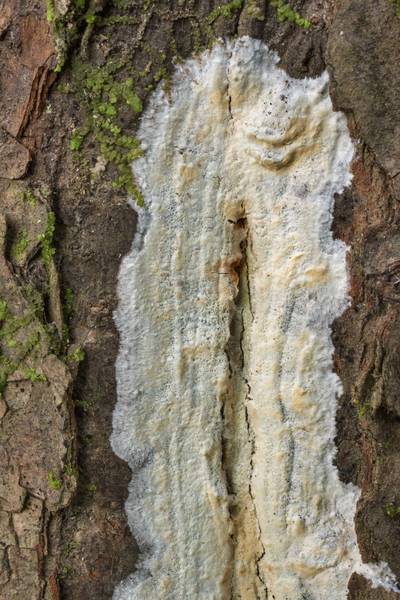

White corticioid fungus around a damaged spot on a Mexican plum tree in Lick Creek ParkLick Creek: Background Notes. College Station, Texas


Album 2737: College Station and Sam Houston Forest, Texas, July 5 - 11, 2020
The image shows a close-up photograph of a white corticioid fungus growing on the trunk of a Mexican plum tree in Lick Creek Park, College Station, Texas. The photo was taken by Dr. Richard C. Kuntz, Professor Emeritus at Texas A&M University.
**Key Features:**
* **Tree Trunk:** The trunk is brown with rough bark and green moss growing on it.
* **Fungus Growth:** White corticioid fungus has grown in a vertical stripe around an obvious crack or damaged spot on the tree. Corticioid fungi are characterized by their ability to grow in thin layers, often forming white or cream-colored growths on the surface of trees and other plants. They can be beneficial, breaking down organic matter and recycling nutrients, but they can also cause damage if left unchecked.
* **Texture:** The texture of the fungus is soft and fuzzy, with a rougher edge where it meets the tree bark.
**Overall Impression:**
The image suggests that the Mexican plum tree in Lick Creek Park has been damaged or injured at some point, possibly due to disease, pests, or environmental stressors. The white corticioid fungus has grown on the surface of the tree, potentially indicating a compromised immune system or nutrient deficiency. However, without more information about the specific conditions surrounding the tree's growth and development, it is difficult to determine the exact cause of the damage.
**Conclusion:**
The image provides a detailed view of a white corticioid fungus growing on the trunk of a Mexican plum tree in Lick Creek Park. The fungus appears to be growing around an obvious crack or damaged spot on the tree, suggesting that the tree may have been injured at some point. While the fungus can be beneficial in certain contexts, it can also cause damage if left unchecked. Further research would be necessary to determine the specific cause of the damage and the role of the fungus in this process. – AI vision
🇪🇸 Descripción en español / Spanish Description
Un hongo corticial blanco alrededor de una mancha dañada en un árbol de ciruela mexicana en el Lick Creek Park. College Station, Texas, 5 de julio de 2020. La imagen muestra una fotografía de cerca de un hongo corticial blanco creciendo en el tronco de un árbol de ciruela mexicana en el Lick Creek Park, College Station, Texas. La foto fue tomada por el Dr. Richard C. Kuntz, Profesor Emérito en la Universidad A&M de Texas. **Principales características:** * **Tronco del árbol:** El tronco es marrón con corteza rugosa y musgo verde creciendo sobre él. * **Crecimiento fúngico:** Hongo corticial blanco ha crecido en una franja vertical alrededor de una grieta obvia o punto dañado en el árbol. Los hongos corticiales se caracterizan por su capacidad para crecer en capas delgadas, a menudo formando crecimientos blancos o de color crema en la superficie de los árboles y otras plantas. Pueden ser beneficiosos, descomponiendo materia orgánica y reciclando nutrientes, pero también pueden causar daños si no se controlan. * **Textura:** La textura del hongo es suave y peluda, con un borde más áspero donde hace contacto con la corteza del árbol. **Impresión general:** La imagen sugiere que el árbol de ciruela mexicana en Lick Creek Park se ha dañado o lesionado en algún momento, posiblemente debido a enfermedades, plagas u otras condiciones estresantes. El hongo corticial blanco ha crecido en la superficie del árbol, potencialmente indicando un sistema inmunitario comprometido o una deficiencia de nutrientes. Sin embargo, sin más información sobre las condiciones específicas que rodean el crecimiento y desarrollo del árbol, es difícil determinar la causa exacta del daño. **Conclusión:** La imagen proporciona una vista detallada de un hongo corticial blanco creciendo en el tronco de un árbol de ciruela mexicana en Lick Creek Park. El hongo parece estar creciendo alrededor de una grieta obvia o punto dañado en el árbol, lo que sugiere que el árbol pudo haberse lesionado en algún momento. Aunque el hongo puede ser beneficioso en ciertos contextos, también puede causar daños si no se controlan. Sería necesaria más investigación para determinar la causa específica del daño y el papel que desempeña el hongo en este proceso. – Spanish translation