 |
| |||||||||||||||||

| ||||||||||||||||||


| Similar | 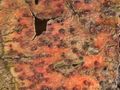  |
  |
  |
  |
  |
| |||||||||||||||||||||||||||||
| |||||||||||||||||||||||||||||
| 1996 1997 1998 1999 2000 2001 2002 2003 2004 2005 2006 2007 2008 2009 2010 2011 2012 2013 2014 2015 2016 2017 2018 2019 2020 2021 2022 2023 2024 2025 2026 | |||||||||||||||||||||||||||||
| New version Slide Show Most Popular Full List Statistics Technical Details Home Page | |||||||||||||||||||||||||||||
The bark of an oak tree that had fallen in Huntsville State Park's Chinquapin Trail displayed a vibrant texture of Pyrenula cruenta, commonly known as the rash lichen, on October 30, 2020. The intricate patterns and colors of this crustose lichen species created a visually striking display on the tree's bark. – generated by AI |
The image presents a close-up view of the bark rash lichen (Pyrenula cruenta), specifically highlighting its texture and pattern on a fallen oak tree trunk located along Chinquapin Trail within Huntsville State Park in Texas. The photograph was captured on October 30, 2020. Upon careful observation, it becomes evident that the lichen has successfully colonized the surface of the dead oak tree. The lichen's red hue is predominantly visible, with some brown and gray tones scattered throughout the bark. This coloration likely results from a combination of factors, including the presence of various pigments such as carotenoids, phenolic compounds, and anthocyanins. The texture of the lichen is notable for its rough appearance, characterized by numerous small cracks and crevices across the surface. These features are typical of many lichens that grow on tree bark, providing a suitable substrate for their survival. The overall pattern of the lichen is irregular, with some areas displaying a more uniform red coloration while others exhibit a mix of colors. The background of the image consists solely of the dead oak tree trunk, which serves as the host surface for the lichen growth. The bark itself appears weathered and worn, with visible signs of aging such as cracks and fissures. This suggests that the tree has been dead for an extended period, providing ample time for the lichen to establish itself. In conclusion, the image effectively showcases the unique characteristics of the bark rash lichen (Pyrenula cruenta) on a fallen oak tree trunk in Huntsville State Park, Texas. The combination of its red coloration, rough texture, and irregular pattern highlights the adaptability and resilience of this species in colonizing dead tree surfaces. – AI vision |
Textura de la líquen corteza (Pyrenula cruenta) en un roble caído en el Sendero Chinquapin del Parque Estatal Huntsville. Texas, 30 de octubre de 2020. La imagen presenta una vista detallada del líquen corteza (Pyrenula cruenta), destacando especialmente su textura y patrón en un tronco de roble caído ubicado a lo largo del Sendero Chinquapin dentro del Parque Estatal Huntsville en Texas. La fotografía fue capturada el 30 de octubre de 2020. Tras una observación cuidadosa, se vuelve evidente que el líquen ha colonizado con éxito la superficie del roble muerto. El matiz rojo del líquen es predominantemente visible, con algunos tonos marrones y grises dispersos a lo largo de la corteza. Este coloreado probablemente sea el resultado de una combinación de factores, incluyendo la presencia de varios pigmentos como los carotenoides, compuestos fenólicos y antocianinas. La textura del líquen es notable por su aspecto áspero, caracterizado por numerosas grietas pequeñas y hendiduras a lo largo de la superficie. Estas características son típicas de muchos líquenes que crecen en corteza de árboles, proporcionando un sustrato adecuado para su supervivencia. El patrón general del líquen es irregular, mostrando algunas áreas con una coloración roja más uniforme mientras otras presentan una mezcla de colores. El fondo de la imagen consiste únicamente en el tronco muerto del roble, que sirve como superficie hospedadora para el crecimiento del líquen. La corteza misma aparece desgastada y desgastada, con signos visibles de envejecimiento tales como grietas y fisuras. Esto sugiere que el árbol ha estado muerto durante un período prolongado, proporcionando tiempo suficiente para que el líquen se establezca. En conclusión, la imagen muestra efectivamente las características únicas del líquen corteza (Pyrenula cruenta) en un tronco de roble caído en el Sendero Chinquapin del Parque Estatal Huntsville, Texas. La combinación de su coloración roja, textura áspera e irregular patrón destaca la adaptabilidad y resiliencia de esta especie en colonizar superficies de árboles muertos. – Spanish translation |
| [+] | bark texture | |
| [+] | oak bark | |
| [+] | texas texture |
Keyword variants
high resolution online digital collection
Huntsville State Park photo
Lone Star State
Chinquapin Trail pic
United States
picture gallery
photo album
Huntsville SP
documentary photographs
daily pics
TX
travelogue
snapshots
sightseeing
photowalks
photoblog
graphic
fotografias
foto
America