
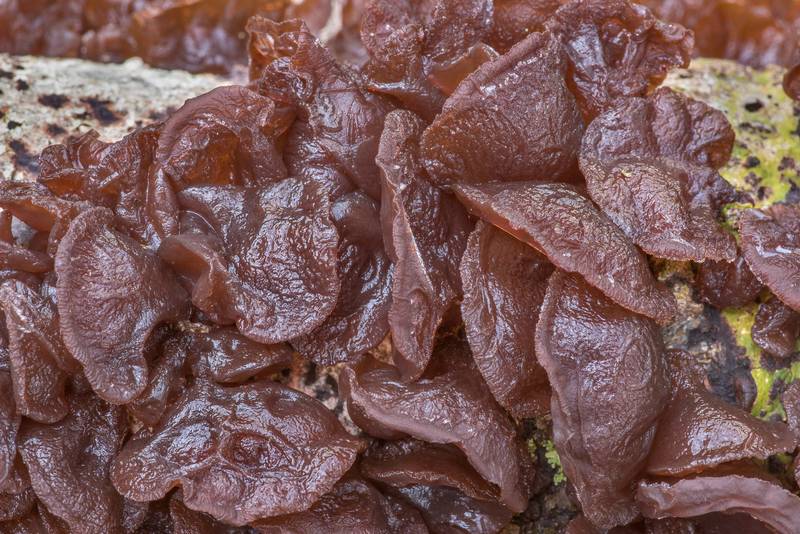

Close-up of amber jelly fungus (Exidia recisa) on a small oak(?) branch in Lick Creek ParkLick Creek: Background Notes. College Station, Texas


Album 2844: College Station, Texas, January 3, 2021
The image presents a close-up view of amber jelly fungus (Exidia recisa), showcasing its unique appearance and habitat.
* **Background**
* The background features a small oak branch, likely from an oak tree.
* The branch exhibits signs of decay or rot, which is not uncommon for fungal growth.
* **Fungus Appearance**
* The amber jelly fungus has a distinctive translucent appearance, giving it a gelatinous or jelly-like texture.
* Its color ranges from light brown to reddish-brown, with some specimens appearing more vibrant than others.
* The fungus is irregularly shaped and lacks a distinct cap or stem, instead forming clusters of small, rounded masses.
* **Size**
* Due to the close-up nature of the image, it is challenging to determine the exact size of the amber jelly fungus.
* However, based on the scale provided by the branch in the background, each cluster appears to be approximately 1-2 centimeters (0.4-0.8 inches) in diameter.
* **Habitat**
* The amber jelly fungus is typically found growing on decaying wood, particularly oak trees.
* Its presence on this small oak branch suggests that it has colonized a suitable substrate for growth.
In summary, the image provides a detailed view of amber jelly fungus (Exidia recisa) growing on a small oak branch. The fungus exhibits its characteristic translucent appearance and gelatinous texture, with clusters forming irregularly shaped masses. Its presence on decaying wood highlights the importance of fungi in breaking down organic matter and recycling nutrients in ecosystems. – AI vision
🇪🇸 Descripción en español / Spanish Description
Primer plano del hongo jelly ámbar (Exidia recisa) en un ramal de roble pequeño (¿?) en Lick Creek Park. College Station, Texas, 3 de enero de 2021. La imagen presenta una vista detallada del hongo jelly ámbar (Exidia recisa), que destaca su apariencia y hábitat únicos.
**Antecedentes** * El fondo muestra un ramal pequeño de roble, probablemente de un árbol de roble. * El ramal presenta signos de descomposición o podredumbre, lo que no es infrecuente para el crecimiento fúngico.
**Apariencia del hongo** * El hongo jelly ámbar tiene una apariencia translúcida distintiva, dándole una textura gelatinosa o similar a la gelatina. * Su color varía de marrón claro a marrón rojizo, con algunos ejemplares que aparecen más vibrantes que otros. * El hongo tiene forma irregular y carece de un capuchón o tallo distintivos, formando en su lugar grupos de pequeñas masas redondeadas.
**Tamaño** * Debido a la naturaleza detallada de la imagen, es difícil determinar el tamaño exacto del hongo jelly ámbar. * Sin embargo, con base en la escala proporcionada por el ramal en el fondo, cada grupo parece tener un diámetro de aproximadamente 1-2 centímetros (0.4-0.8 pulgadas).
**Hábitat** * El hongo jelly ámbar se encuentra normalmente creciendo en madera en descomposición, particularmente árboles de roble. * Su presencia en este ramal pequeño de roble sugiere que ha colonizado un sustrato adecuado para el crecimiento. En resumen, la imagen proporciona una vista detallada del hongo jelly ámbar (Exidia recisa) creciendo en un ramal pequeño de roble. El hongo exhibe su apariencia translúcida característica y textura gelatinosa, con grupos que forman masas irregularmente conformadas. Su presencia en madera en descomposición destaca la importancia de los hongos en romper materia orgánica y reciclar nutrientes en ecosistemas. – Spanish translation


