
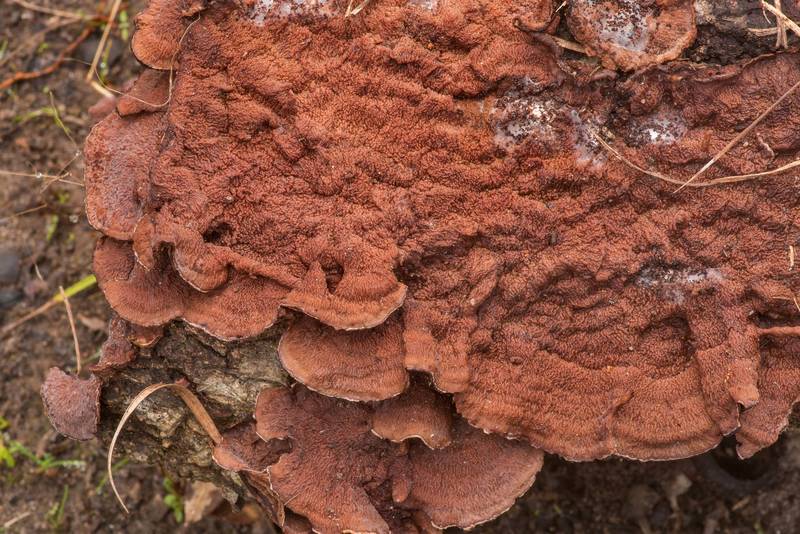

Overlapping caps of fungus Phlebia rufa(?) on a cut piece of Mexican plum or may be oak in Lick Creek ParkLick Creek: Background Notes. College Station, Texas


Album 2854: College Station, Texas, January 21, 2021
The image showcases the upper surface of a fungal colony featuring overlapping caps that are reddish-brown in color with white edges and fine hairs. The stems are not visible as they are buried beneath the caps.
**Environmental Context**
* The fungus appears to be growing on a cut piece of Mexican plum or oak tree.
* Lick Creek Park is located in College Station, Texas.
* The image was captured on January 21, 2021.
**Observations and Speculations**
* Based on the information provided, it can be inferred that the caps are likely from Phlebia rufa, a type of fungus commonly found growing on decaying wood or tree stumps. However, without more context or evidence, this identification is speculative.
* The reddish-brown coloration and overlapping caps of the fungal colony are consistent with Phlebia rufa.
* The fact that the fungus is growing on a cut piece of Mexican plum or oak tree suggests that it may have been introduced to the area through human activity, such as gardening or landscaping.
**Conclusion**
While the image provides some clues about the identity and environment of the fungal colony, further research and analysis would be necessary to confirm its classification. – AI vision
🇪🇸 Descripción en español / Spanish Description
Las cápsulas solapadas del hongo Phlebia rufa(?) en un trozo cortado de ciruela mexicana o robles posiblemente en Lick Creek Park. College Station, Texas, 21 de enero de 2021. La imagen muestra la superficie superior de una colonia fúngica con cápsulas solapadas que son de color marrón rojizo con bordes blancos y pelos finos. Los tallos no son visibles ya que están enterrados debajo de las tapas. **Contexto ambiental** * El hongo parece crecer en un trozo cortado de ciruela mexicana o robles. * Lick Creek Park se encuentra en College Station, Texas. * La imagen fue capturada el 21 de enero de 2021. **Observaciones y especulaciones** * Basándose en la información proporcionada, puede inferirse que las tapas son probablemente de Phlebia rufa, un tipo de hongo comúnmente encontrado creciendo en madera en descomposición o troncos podridos. Sin embargo, sin más contexto ni evidencia, esta identificación es especulativa. * La coloración marrón rojiza y las tapas solapadas de la colonia fúngica son consistentes con Phlebia rufa. * El hecho de que el hongo crezca en un trozo cortado de ciruela mexicana o robles sugiere que podría haber sido introducido en el área a través de actividades humanas, como jardinería o paisajismo. **Conclusión** Aunque la imagen proporciona algunos indicios sobre la identidad y el entorno de la colonia fúngica, se necesitarían más investigación y análisis para confirmar su clasificación. – Spanish translation


