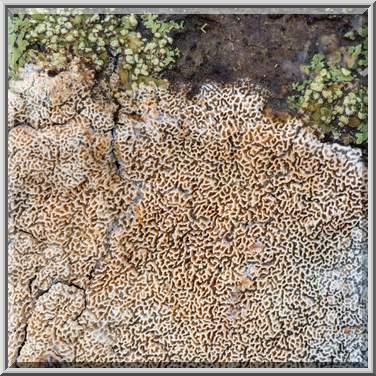
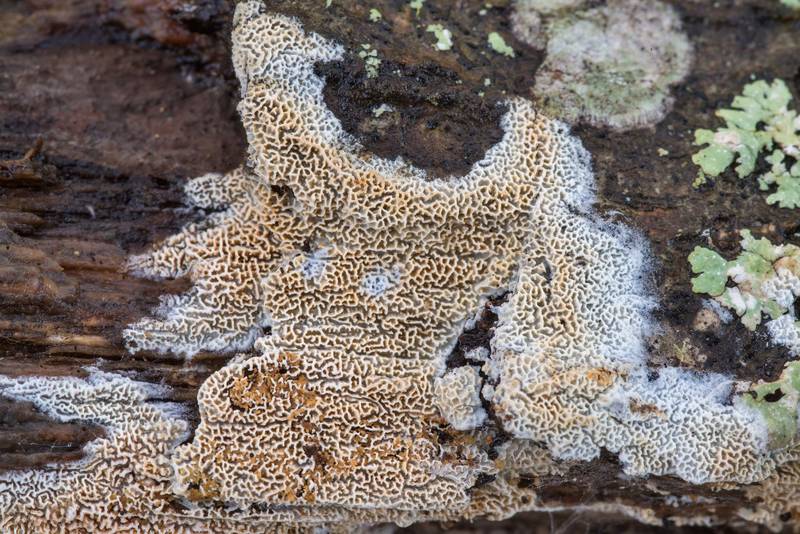
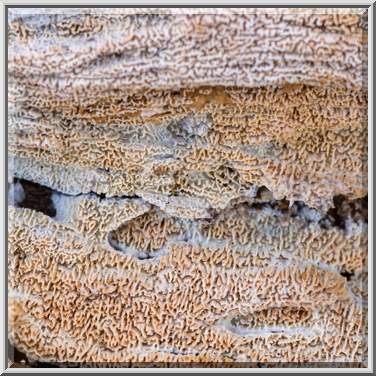
Texture of corticioid mushroom Ceriporia reticulata(?) on a fallen oak in Lick Creek ParkLick Creek: Background Notes. College Station, Texas


Album 2875: College Station, Texas, March 1 - 2, 2021
The image depicts the texture of Corticioid Mushroom Ceriporia reticulata(? On a fallen oak tree in Lick Creek Park. College Station, Texas, March 2, 2021.
The fungus grows on the surface and crevices of the bark, forming intricate patterns with its white mycelia. The fungus appears to be growing from the wood grain, giving it a rough texture.
The mushroom is small in size, likely around one or two inches long. This gives it a compact appearance that blends well into the surrounding environment. The white color of the fungus stands out against the darker tones of the bark, making it slightly visible among other growths on the tree's surface.
The fallen oak tree serves as a substrate for this corticioid mushroom to grow on. The texture and roughness of the wood provide suitable conditions for the fungus to thrive, while its white mycelia help it blend in with the surrounding environment.
The image provides insight into the unique characteristics of Ceriporia reticulata(?) and its ability to adapt to different environments, including fallen trees in Lick Creek Park. – AI vision
🇪🇸 Descripción en español / Spanish Description
Textura del hongo corticial Ceriporia reticulata(?) en un roble caído en Lick Creek Park. College Station, Texas, 2 de marzo de 2021. La imagen muestra la textura del Hongo Corticial Ceriporia reticulata(? En un roble caído en el parque de Lick Creek. College Station, Texas, 2 de marzo de 2021. El hongo crece en la superficie y las grietas de la corteza, formando patrones complejos con su micelio blanco. El hongo parece estar creciendo desde el grano de la madera, dándole una textura rugosa. El hongo es pequeño de tamaño, probablemente alrededor de una o dos pulgadas de largo. Esto le da un aspecto compacto que se mezcla bien con el entorno circundante. El color blanco del hongo sobresale contra los tonos más oscuros de la corteza, lo que lo hace ligeramente visible entre otros crecimientos en la superficie del árbol. El roble caído sirve como sustrato para el crecimiento de este hongo corticial. La textura y la rugosidad de la madera proporcionan condiciones adecuadas para que el hongo prospere, mientras que su micelio blanco lo ayuda a mezclarse con el entorno circundante. La imagen proporciona información sobre las características únicas de Ceriporia reticulata(?) y su capacidad para adaptarse a diferentes entornos, incluidos los árboles caídos en Lick Creek Park. – Spanish translation


