
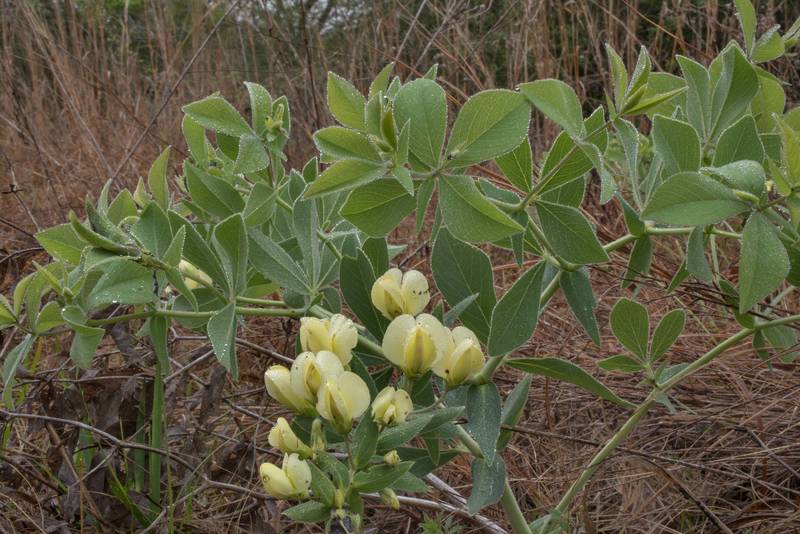

False indigo (bush pea, yellow wisteria, Baptisia bracteata) near Post Oak Trail in Lick Creek ParkLick Creek: Background Notes. College Station, Texas


Album 2890: College Station, Texas, March 24, 2021
The image captures a close-up view of False Indigo (Baptisia bracteata), also known as Bush Pea or Yellow Wisteria, thriving near Post Oak Trail in Lick Creek Park, College Station, Texas. The photograph was taken on March 24, 2021.
In the foreground, the plant's bright green leaves and stems are prominent, with a cluster of yellow flowers at its center. The foliage is covered in fine hairs that give it a velvety appearance. The leaves have three leaflets attached to their ends by short petioles (leaf stalks). Each leaflet has deep lobes or sinuses, giving them an overall rounded shape.
The plant's stem is sturdy and woody near the base but becomes more slender as it ascends. Multiple branches emerge from the main stem, bearing leaves and flowers along their length. The yellow flowers are arranged in clusters at the ends of these branches, adding a vibrant touch to the scene.
In the background, the natural habitat of the plant is visible. Dead grasses and twigs cover the ground, while tall trees rise into the distance. A few other plants can be seen growing nearby, including what appears to be another bush pea or possibly some type of wildflower.
Overall, the image provides a detailed look at the False Indigo plant in its natural environment, showcasing its unique features and beauty. – AI vision
🇪🇸 Descripción en español / Spanish Description
La falsa índigo (Baptisia bracteata) cerca del sendero Post Oak en el parque Lick Creek. College Station, Texas, 24 de marzo de 2021. La imagen muestra una vista cercana de la falsa índigo (Baptisia bracteata), también conocida como Bush Pea o Yellow Wisteria, que crece cerca del sendero Post Oak en el parque Lick Creek, College Station, Texas. La fotografía se tomó el 24 de marzo de 2021. En primer plano, destacan las hojas y tallos verdes brillantes de la planta, con una agrupación de flores amarillas en su centro. El follaje está cubierto de pelillos finos que le dan un aspecto velludo. Las hojas tienen tres lóbulos unidos a sus extremos por cortos peciolos (tallos de las hojas). Cada hoja tiene lóbulos o senos profundos, lo que les da una forma redondeada en general. El tallo de la planta es robusto y leñoso cerca de la base, pero se vuelve más delgado a medida que asciende. Múltiples ramas emergen del tallo principal, con hojas y flores a lo largo de su longitud. Las flores amarillas están dispuestas en racimos en los extremos de estas ramas, agregando un toque vibrante a la escena. En el fondo, se puede ver el hábitat natural de la planta. El suelo está cubierto de hierbas muertas y ramitas, mientras que árboles altos se elevan en el horizonte. Se pueden observar otras pocas plantas creciendo cerca, incluyendo lo que parece ser otra Bush Pea o quizás algún tipo de flor silvestre. En general, la imagen proporciona una vista detallada de la falsa índigo en su entorno natural, mostrando sus características únicas y su belleza. – Spanish translation


