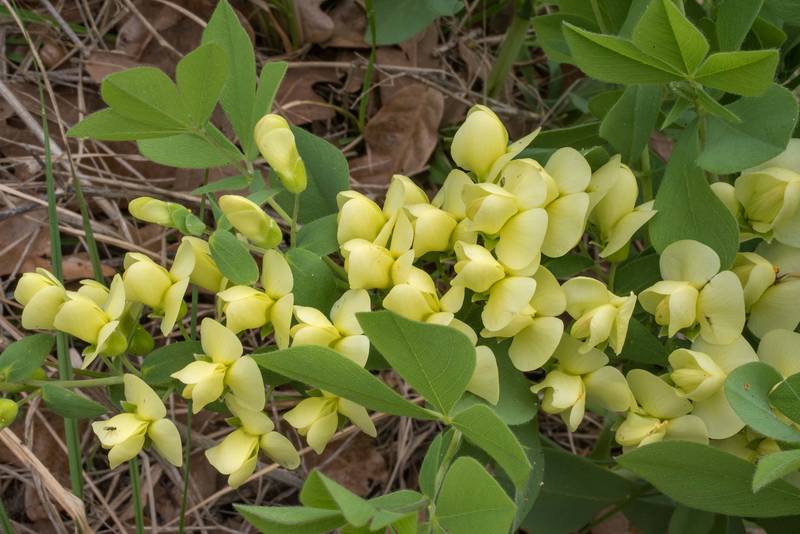
Yellow visteria (Baptisia bracteata) in Lick Creek ParkLick Creek: Background Notes. College Station, Texas


Album 2896: College Station - Sam Houston Forest, Texas, March 30 - April 1, 2021
The image depicts a cluster of yellow flowers with green leaves and stems on the ground. In the background are dead brown leaves and grasses.
* **Flowers**
* There are approximately twenty-five flowers in the image.
* The flowers are small, light-yellow, and have four petals each.
* They are clustered together and appear to be growing from a single stem or branch.
* **Leaves**
* The leaves are green and heart-shaped with pointed tips.
* Some of the leaves are partially open, while others are fully closed.
* They vary in size but appear to be around 1-2 inches long.
* **Stems**
* The stems are thin and brownish-green in color.
* They are covered with small hairs or fuzz.
* Some of the stems have thorns or prickles along their length.
* **Background**
* The background is a mix of dead leaves, twigs, and grasses.
* The ground appears to be dry and cracked in some areas.
The image suggests that the flowers are growing wild in a natural setting. They appear to be healthy and thriving, with no visible signs of disease or pests. – AI vision
🇪🇸 Descripción en español / Spanish Description
La flor de la viscaria amarilla (Baptisia bracteata) en el Lick Creek Park. College Station, Texas, el 30 de marzo de 2021. La imagen muestra un racimo de flores amarillas con hojas y tallos verdes en el suelo. En segundo plano hay hojas secas marrones y pasto. * **Flores** * Hay aproximadamente veinticinco flores en la imagen. * Las flores son pequeñas, amarillo claro y tienen cuatro pétalos cada una. * Están agrupadas juntas y parecen crecer desde un único tallo o rama. * **Hojas** * Las hojas son verdes y en forma de corazón con puntas afiladas. * Algunas de las hojas están parcialmente abiertas, mientras que otras están completamente cerradas. * Varian en tamaño pero parecen estar alrededor de 1-2 pulgadas de largo. * **Tallos** * Los tallos son delgados y de color verde parduzco. * Están cubiertos con pequeños pelos o pelusa. * Algunos de los tallos tienen espinas o púas a lo largo de su longitud. * **Fondo** * El fondo es una mezcla de hojas secas, ramitas y pasto. * El suelo parece seco y agrietado en algunas áreas. La imagen sugiere que las flores están creciendo de manera silvestre en un entorno natural. Parecen saludables y prósperos, sin signos visibles de enfermedad o plagas. – Spanish translation