
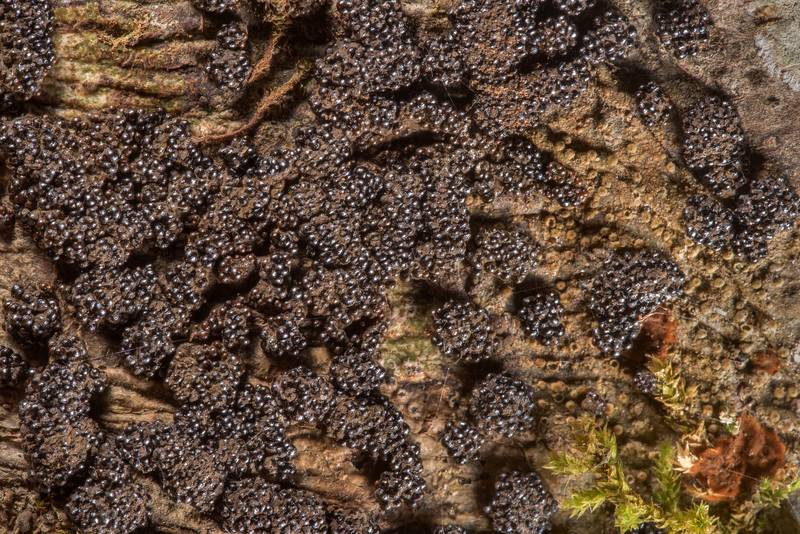

Wasp nest slime mold (Metatrichia vesparia) on a tree on Caney Creek Trail (Little Lake Creek Loop Trail) in Sam Houston National Forest north from Montgomery. Texas


Album 2964: Sam Houston Forest, Texas, June 13, 2021
The image depicts a unique scene of a wasp nest slime mold, specifically Metatrichia vesparia, growing on the surface of a tree trunk located on Caney Creek Trail (Little Lake Creek Loop Trail) within Sam Houston National Forest north from Montgomery, Texas.
Upon closer inspection, it becomes apparent that the slime mold has formed a cluster-like structure on the bark of the tree. The texture and coloration of the slime mold are brownish-black in hue, featuring a rough and bumpy surface with a somewhat granular appearance. As one observes the image from left to right, the presence of other organic material is noticeable at the bottom.
The overall context of this image provides valuable insights into the fascinating world of fungi and their ability to thrive in diverse environments, including tree bark. The observation of Metatrichia vesparia on a tree trunk highlights its unique characteristics as a slime mold species that can colonize various surfaces, contributing to our understanding of these organisms' ecological roles.
*Answer*: The image captures a wasp nest slime mold (Metatrichia vesparia) growing on the surface of a tree trunk within Sam Houston National Forest. – AI vision
🇪🇸 Descripción en español / Spanish Description
El moho del limo de nido de avispa (Metatrichia vesparia) en un árbol en el Caney Creek Trail (Little Lake Creek Loop Trail) en la Selva Nacional de Sam Houston al norte de Montgomery, Texas, el 13 de junio de 2021. La imagen representa una escena única de un moho del limo de nido de avispa, específicamente Metatrichia vesparia, creciendo en la superficie del tronco de un árbol ubicado en Caney Creek Trail (Little Lake Creek Loop Trail) dentro de Sam Houston National Forest al norte de Montgomery, Texas. Al inspeccionarlo más de cerca, se hace evidente que el moho ha formado una estructura similar a un grupo en la corteza del árbol. La textura y coloración del moho son marrones oscuras, con una superficie rugosa y bultuda con un aspecto granuloso. Al observar la imagen de izquierda a derecha, se aprecia la presencia de otro material orgánico en la parte inferior. El contexto general de esta imagen proporciona información valiosa sobre el fascinante mundo de los hongos y su capacidad para prosperar en entornos diversos, incluidas las corteza de los árboles. La observación de Metatrichia vesparia en el tronco de un árbol destaca sus características únicas como una especie de moho del limo que puede colonizar diversas superficies, lo que contribuye a nuestra comprensión de los roles ecológicos de estos organismos. *Respuesta*: La imagen captura un moho del limo de nido de avispa (Metatrichia vesparia) creciendo en la superficie de un tronco de árbol dentro de Sam Houston National Forest. – Spanish translation


