
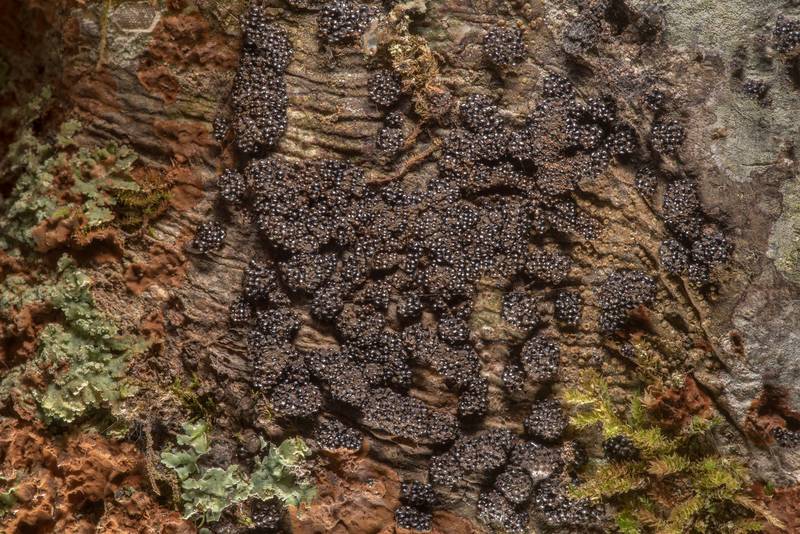

Wasp nest slime mold (Metatrichia vesparia) on bark of a tree on Caney Creek Trail (Little Lake Creek Loop Trail) in Sam Houston National Forest north from Montgomery. Texas


Album 2964: Sam Houston Forest, Texas, June 13, 2021
The image depicts a close-up view of a tree trunk covered with various lichens and fungi, including Wasp nest slime mold (Metatrichia vesparia).
**Tree Trunk:**
* The tree trunk is brown and rough, indicating it is likely an older tree.
* The bark appears to be weathered, suggesting exposure to the elements for a significant period.
**Lichens and Fungi:**
* Several species of lichens are visible on the tree trunk, including green, orange, and yellow hues. These lichens have flat, leafy or branching structures and can form dense mats.
* A variety of fungi, including some with black caps, are also present on the tree trunk. Some appear to be growing in clusters or patches.
**Wasp Nest Slime Mold (Metatrichia vesparia):**
* The Wasp nest slime mold is a type of fungus that grows on trees and other surfaces.
* It has small, round, black caps that resemble wasp nests, hence its common name. These caps are actually the fruiting bodies of the fungus.
**Overall:**
The image provides a detailed view of the diverse range of lichens and fungi that can be found growing on tree trunks in natural environments. The presence of multiple species highlights the importance of preserving these ecosystems and protecting the biodiversity they support. – AI vision
🇪🇸 Descripción en español / Spanish Description
El moho espeso de la marca de nidos de avispas (Metatrichia vesparia) en la corteza de un árbol del Sendero Caney Creek (Sendero Little Lake Creek Loop) en el Bosque Nacional Sam Houston, al norte de Montgomery. Texas, 13 de junio de 2021. La imagen muestra una vista detallada de un tronco de árbol cubierto con diversos líquenes y hongos, incluido el moho espeso de la marca de nidos de avispas (Metatrichia vesparia). **Tronco del Árbol:** * El tronco del árbol es marrón y rugoso, lo que indica que probablemente sea un árbol viejo. * La corteza parece haber sufrido la acción de los agentes atmosféricos durante un período prolongado. **Líquenes y Hongos:** * Se pueden observar varias especies de líquenes en el tronco del árbol, incluidas tonalidades verdes, naranjas y amarillas. Estos líquenes tienen estructuras planas, foliadas o ramificadas y pueden formar espesas capas. * También hay una variedad de hongos, algunos con tapas negras, presentes en el tronco del árbol. Algunos parecen estar creciendo agrupados o en parches. **Moho espeso de la marca de nidos de avispas (Metatrichia vesparia):** * El moho espeso de la marca de nidos de avispas es una especie de hongo que crece en árboles y otras superficies. * Tiene pequeñas cubiertas negras redondas que recuerdan a los nidos de avispa, por lo que se les conoce con ese nombre común. Estas tapas son en realidad los cuerpos frutales del hongo. **En general:** La imagen muestra una vista detallada de la diversa gama de líquenes y hongos que crecen en troncos de árboles en entornos naturales. La presencia de múltiples especies resalta la importancia de preservar estos ecosistemas y proteger la biodiversidad que soportan. – Spanish translation


