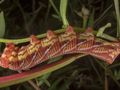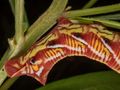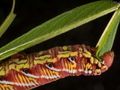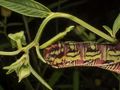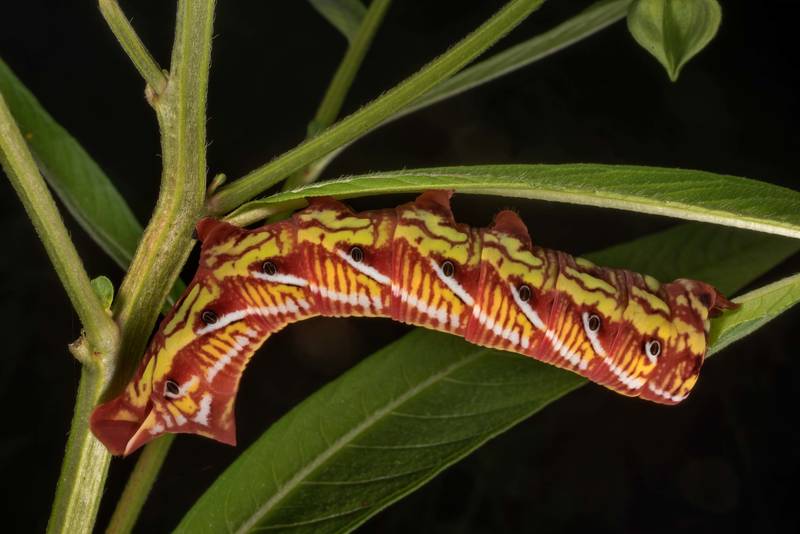

Hornworm of Lesser Vine Sphinx Moth (Banded Sphinx Moth, Eumorpha fasciatus) on water-primrose (Ludwigia, Onagraceae) in Lick Creek ParkLick Creek: Background Notes. College Station, Texas


Album 3005: College Station, Texas, August 11 - 12, 2021
The image features a Hornworm caterpillar of the Lesser Vine Sphinx Moth, also known as Banded Sphinx Moth (Eumorpha fasciatus), perched on a water-primrose plant (Ludwigia, Onagraceae) in Lick Creek Park.
**Caterpillar:**
* The caterpillar is prominently displayed in the center of the image.
* Its body is characterized by alternating yellow and brown stripes, with black dots along its length.
* Each segment features a distinctive white stripe that runs down the middle.
* The head is reddish-brown, featuring two small horns on top.
**Plant:**
* The plant is identified as water-primrose (Ludwigia).
* It has long green stems with pointed leaves.
* Multiple stems are visible in the image, all of which are supporting the caterpillar.
**Background:**
* The background is dark and out-of-focus, suggesting that the image was captured at night or in low-light conditions.
Overall, the image showcases a striking example of a Hornworm caterpillar on its host plant, providing valuable insights into the life cycle and habits of this species. – AI vision
🇪🇸 Descripción en español / Spanish Description
El gusano del hilo de la polilla menor Vine (polilla moteada, Eumorpha fasciatus) en primavera acuática (Ludwigia, Onagraceae) en Lick Creek Park. College Station, Texas, agosto 12, 2021. La imagen muestra una larva de gusano del hilo de la polilla menor, también conocida como polilla moteada (Eumorpha fasciatus), perchada en una planta de primavera acuática (Ludwigia, Onagraceae) en Lick Creek Park. **Larva**: * La larva se muestra prominentemente en el centro de la imagen. * Su cuerpo está caracterizado por rayas alternantes amarillas y marrones, con puntos negros a lo largo de su longitud. * Cada segmento cuenta con una distintiva franja blanca que corre por el medio. * La cabeza es parda rojiza, con dos pequeños cuernos en la parte superior. **Planta:** * La planta se identifica como primavera acuática (Ludwigia). * Tiene largos tallos verdes con hojas puntiagudas. * Son visibles múltiples tallos en la imagen, todos los cuales sostienen a la larva. **Antecedentes:** * El fondo es oscuro y desenfocado, lo que sugiere que la imagen fue capturada de noche o en condiciones de poca luz. En general, la imagen muestra un ejemplo impactante de una larva de gusano del hilo en su planta anfitriona, proporcionando información valiosa sobre el ciclo vital y los hábitos de esta especie. – Spanish translation