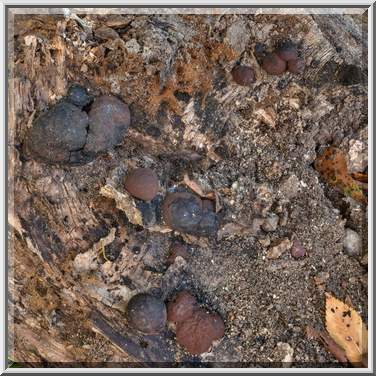
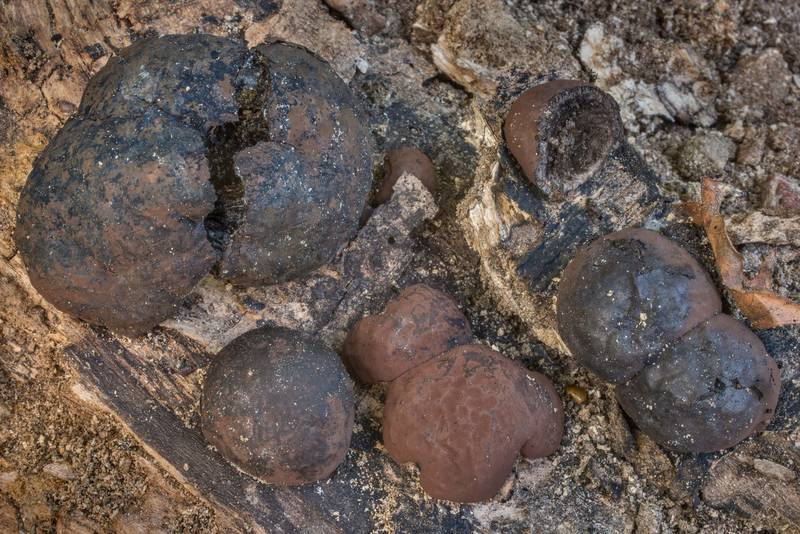
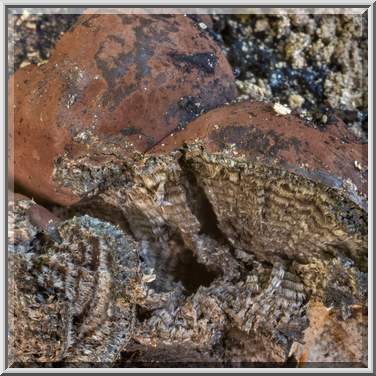
Cramp balls fungus (Daldinia concentrica) on a rotting oak log in Lick Creek ParkLick Creek: Background Notes. College Station, Texas


Album 3011: College Station - Sam Houston Forest, Texas, August 19 - 22, 2021
The image presents a close-up view of several cramp balls fungi growing on a decaying oak log within Lick Creek Park, College Station, Texas.
**Fungi Description**
The fungi are characterized by their dark brown to black color and irregularly shaped bodies, with varying sizes ranging from small to large. The largest specimen is situated at the top left corner of the image, while the smallest can be found at the bottom left. All of these specimens appear to have been broken in half, revealing a lighter-colored interior. Several other cramp balls fungi are visible in the background and on different parts of the log.
**Background**
The decaying oak log provides a natural substrate for the fungi to grow upon. The wood is rotting and has developed cracks, allowing the fungi to thrive. The surrounding environment appears to be humid, as indicated by the presence of moss or other small plants growing near the base of the log.
**Overall Impression**
The image showcases the unique characteristics of cramp balls fungi and their ability to grow on decaying wood. It also highlights the importance of preserving natural habitats like Lick Creek Park, which provide a home for these fascinating organisms. – AI vision
🇪🇸 Descripción en español / Spanish Description
Las bolas de calambre del hongo (Daldinia concentrica) en un tronco podrido de roble en el Parque Lick Creek. College Station, Texas, 21 de agosto de 2021. La imagen presenta una vista detallada de varias bolas de calambre que crecen en un tronco de roble en descomposición dentro del Parque Lick Creek, College Station, Texas. **Descripción del hongo** Los hongos se caracterizan por su color marrón oscuro a negro y cuerpos de forma irregular, con tamaños variables que van desde pequeños a grandes. El espécimen más grande está situado en la esquina superior izquierda de la imagen, mientras que el más pequeño se encuentra en la parte inferior izquierda. Todos estos especímenes parecen haberse partido por la mitad, revelando un interior de color más claro. Varios otros hongos de bolas de calambre son visibles en el fondo y en diferentes partes del tronco. **Antecedentes** El tronco podrido proporciona un sustrato natural para el crecimiento de los hongos. La madera se está pudriendo y ha desarrollado grietas, lo que permite que los hongos prosperen. El entorno circundante parece ser húmedo, como indica la presencia de musgo u otras pequeñas plantas que crecen cerca de la base del tronco. **Impresión general** La imagen muestra las características únicas de los hongos bolas de calambre y su capacidad para crecer en madera en descomposición. También destaca la importancia de preservar hábitats naturales como el Parque Lick Creek, que proporcionan un hogar para estos fascinantes organismos. – Spanish translation


