
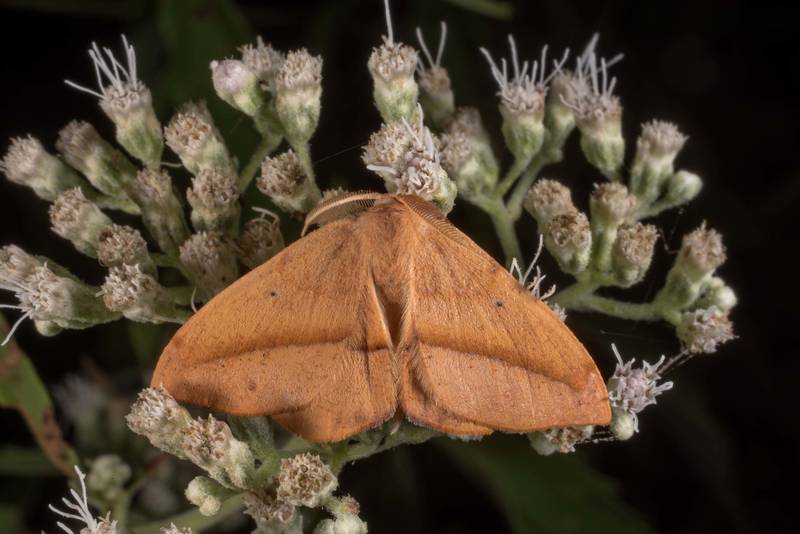

Some orange moth on flowers of late-flowering boneset in Lick Creek ParkLick Creek: Background Notes. College Station, Texas


Album 3019: Sam Houston Forest, College Station, Texas, September 5 - 8, 2021
The image shows an orange moth resting on a plant with small white flowers. The moth is positioned near the center of the image and has a brownish-orange coloration. Its wings are folded against its body, suggesting it may be preparing to rest or roost.
The moth's head is at the top of the image, while its abdomen is pointing downwards towards the base of the plant. It appears to have two long antennae protruding from its head, which could be used for sensing the environment and detecting potential threats.
The plant that the moth is sitting on has small white flowers with thin stems. The flowers are clustered together in a dense arrangement, giving them a somewhat fuzzy appearance. They seem to be blooming late in the season, as suggested by the caption.
In the background of the image, there appears to be more foliage and possibly other plants or trees. However, these details are not clearly visible due to the shallow depth of field used to capture the image.
Overall, the image suggests that the moth is attracted to the flowers on this particular plant, which may provide it with food sources such as nectar or pollen. The late-blooming nature of the boneset flowers could be an important factor in supporting insects like moths during times when other plants have already finished flowering. – AI vision
🇪🇸 Descripción en español / Spanish Description
Alguna lechuza naranja sobre las flores de una planta de hueso de buey tardía en florecer en Lick Creek Park. College Station, Texas, 6 de septiembre de 2021. La imagen muestra a una lechuza naranja descansando en una planta con pequeñas flores blancas. La lechuza está ubicada cerca del centro de la imagen y tiene un color parduzco-naranja. Sus alas están dobladas contra su cuerpo, lo que sugiere que se prepara para descansar o anidar. La cabeza de la lechuza está en la parte superior de la imagen, mientras que su abdomen apunta hacia abajo hacia la base de la planta. Parece tener dos largas antenas salientes de su cabeza, que podrían usarse para percibir el entorno y detectar posibles amenazas. La planta en la que está sentada la lechuza tiene pequeñas flores blancas con tallos delgados. Las flores están agrupadas juntas en una disposición densa, dándoles un aspecto un poco borroso. Parecen florecer tarde en la temporada, como sugiere el subtítulo. En el fondo de la imagen, parece haber más vegetación y posiblemente otras plantas o árboles. Sin embargo, estos detalles no son claramente visibles debido a la poca profundidad de campo utilizada para capturar la imagen. En general, la imagen sugiere que la lechuza es atraída por las flores de esta planta en particular, lo que podría proporcionarle fuentes de alimento como néctar o polen. La naturaleza tardía de las flores de hueso de buey podría ser un factor importante para apoyar a insectos como las lechuzas cuando otras plantas ya han terminado de florecer. – Spanish translation


