
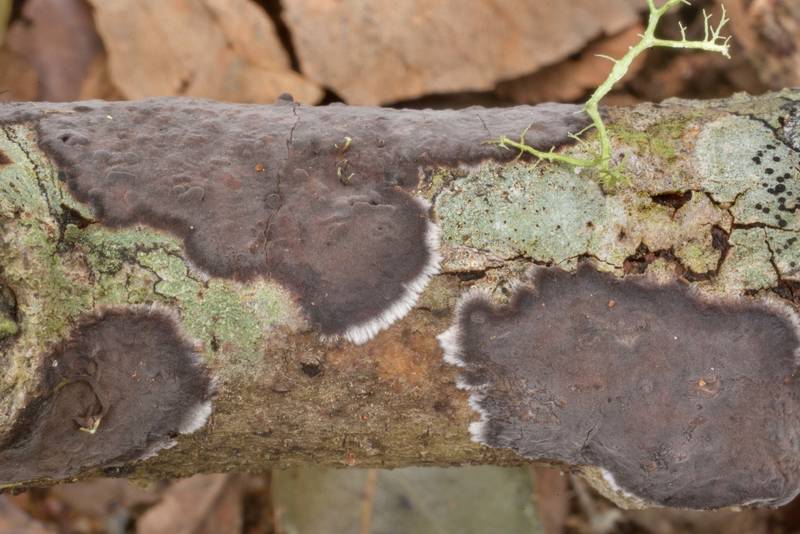

Corticioid fungus Peniophora quercina with white margin on a fallen oak branch in Lick Creek ParkLick Creek: Background Notes. College Station, Texas


Album 3055: College Station - Bryan, Texas, November 9 - 10, 2021
The image showcases a detailed view of a fallen oak branch, featuring a corticioid fungus called Peniophora quercina with a distinctive white margin.
In the foreground, the branch is prominently displayed, exhibiting signs of decay and weathering. The bark appears worn and cracked, with visible cracks running along its length. This suggests that the branch has been exposed to environmental factors for some time, leading to its deterioration.
Atop the branch, several patches of Peniophora quercina are visible, each characterized by a white margin. These patches appear as irregularly shaped spots on the surface of the bark, with some displaying a slightly raised or convex appearance. The fungus itself is dark brown in color and has a rough texture.
In the background, other branches and debris can be seen scattered about, adding context to the scene. The overall atmosphere suggests that the image was captured in a natural setting, possibly during the fall season given the presence of fallen leaves and the deciduous nature of the oak tree.
Overall, the image provides a detailed look at the interaction between a corticioid fungus and its host environment, highlighting the complex relationships within ecosystems. – AI vision
🇪🇸 Descripción en español / Spanish Description
El hongo corticioso Peniophora quercina con un margen blanco en un ramal de roble caído en Lick Creek Park. College Station, Texas, 9 de noviembre de 2021. La imagen muestra una vista detallada de un ramal de roble caído, que presenta un hongo corticioso llamado Peniophora quercina con un margen blanco distintivo. En primer plano, el ramal está prominente, exhibiendo signos de descomposición y erosión. La corteza parece desgastada y agrietada, con grietas visibles a lo largo de su longitud. Esto sugiere que el ramal ha estado expuesto a factores ambientales durante algún tiempo, lo que lleva a su deterioro. En la parte superior del ramal, son visibles varios parches de Peniophora quercina, cada uno caracterizado por un margen blanco. Estos parches aparecen como manchas de forma irregular en la superficie de la corteza, con algunos mostrando una apariencia ligeramente elevada o convexa. El hongo en sí es de color pardo oscuro y tiene una textura áspera. En el fondo, otros ramales y desechos pueden verse dispersos, añadiendo contexto a la escena. La atmósfera general sugiere que la imagen fue capturada en un entorno natural, posiblemente durante la temporada de otoño dado la presencia de hojas caídas y la naturaleza decidua del roble. En general, la imagen proporciona una vista detallada de la interacción entre un hongo corticioso y su entorno, destacando las complejas relaciones dentro de los ecosistemas. – Spanish translation


