
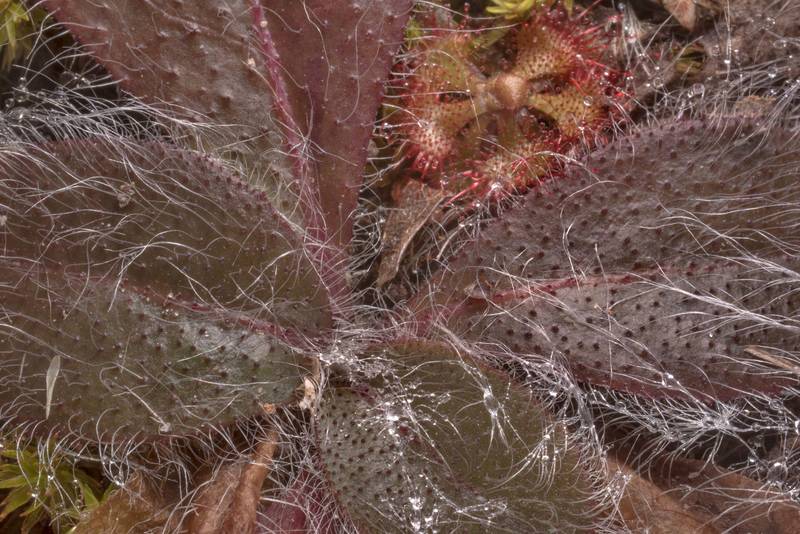

Beaked hawkweed (Hieracium gronovii) and dwarf sundew (Drosera brevifolia) in Lick Creek ParkLick Creek: Background Notes. College Station, Texas


Album 3112: College Station, Texas, February 28 - March 1, 2022
The image showcases a close-up view of two plants: beaked hawkweed and dwarf sundew. The hawkweed is situated on the left side of the image, while the sundew is positioned at the bottom right corner.
Beaked Hawkweed (Hieracium gronovii) is a perennial plant characterized by its distinctive yellow flowers that bloom in late spring to early summer. It has a rosette-like growth habit and produces white, hairy stems with leaves arranged oppositely along them. The leaves are lance-shaped or oval, ranging from light green to dark green in color.
In contrast, the Dwarf Sundew (Drosera brevifolia) is an annual plant that blooms in late spring to early summer. It has small rosettes and produces white stems with leaves arranged oppositely along them. The leaves are lance-shaped or oval, ranging from light green to dark green in color.
Both plants exhibit a hairy texture due to the presence of trichomes on their leaves and stems. Trichomes are specialized epidermal cells that secrete oils, waxes, or other substances to protect the plant from environmental stresses such as drought, heat, and cold.
The image captures the unique characteristics of these two plants, highlighting their distinct growth habits, leaf shapes, colors, and textures. Overall, the image provides a detailed look at the morphology of beaked hawkweed and dwarf sundew, showcasing their adaptations to their environment. – AI vision
🇪🇸 Descripción en español / Spanish Description
El genciano (Hieracium gronovii) y la zarzamora enano (Drosera brevifolia) en el Parque Lick Creek. College Station, Texas, 28 de febrero de 2022. La imagen muestra una vista detallada de dos plantas: genciano y zarzamora enano. El genciano se encuentra a la izquierda de la imagen, mientras que la zarzamora está situada en la esquina inferior derecha. El genciano es una planta perenne caracterizada por sus distintivas flores amarillas que florecen de finales de la primavera a principios del verano. Tiene un hábito de crecimiento similar al de una roseta y produce tallos blancos y peludos con hojas dispuestas opuestamente a lo largo de ellos. Las hojas tienen forma de lámina ovalada, variando en color desde el verde claro al oscuro. Por su parte, la zarzamora enano (Drosera brevifolia) es una planta anual que florece de finales de la primavera a principios del verano. Tiene pequeñas rosetas y produce tallos blancos con hojas dispuestas opuestamente a lo largo de ellos. Las hojas tienen forma de lámina ovalada, variando en color desde el verde claro al oscuro. Ambas plantas presentan una textura peluda debido a la presencia de tricomas en sus hojas y tallos. Los tricomas son células epidérmicas especializadas que secretan aceites, ceras u otras sustancias para proteger la planta del estrés ambiental, como sequía, calor y frío. La imagen captura las características únicas de estas dos plantas, resaltando sus distintos hábitats de crecimiento, formas de hojas, colores e texturas. En general, la imagen proporciona una mirada detallada a la morfología del genciano y la zarzamora enano, mostrando sus adaptaciones al entorno. – Spanish translation


