
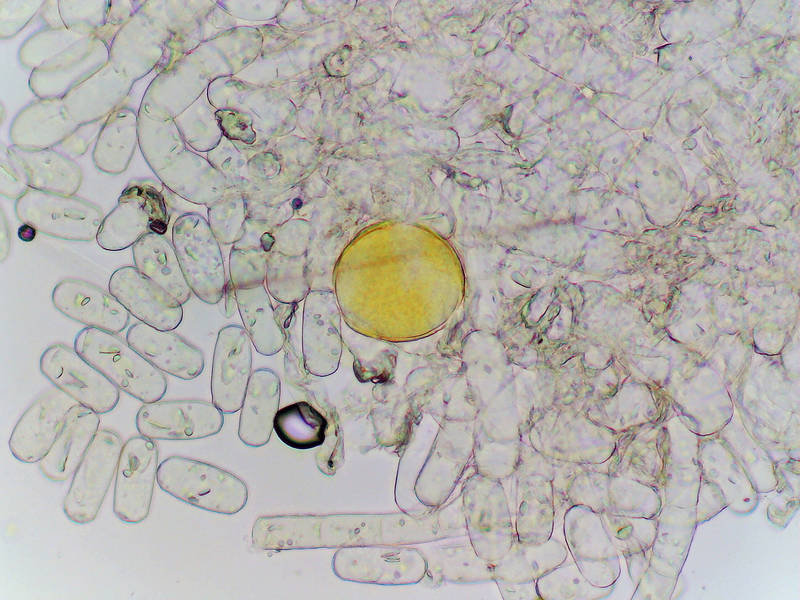

Conidia and cleistothecia, or ascomata (round) in KOH solution of white powdery mildew fungus Podosphaera euphorbiae collected on Raccoon Run Trail in Lick Creek ParkLick Creek: Background Notes. College Station, Texas


Album 3129: College Station, Texas, April 10 - 11, 2022
The image shows a microscopic view of fungal structures using a potassium hydroxide (KOH) solution. The primary focus is on two distinct types of fungal growths: conidia and cleistothecia, also known as ascomata.
**Conidia**
* **Characteristics:** Conidia are single-celled spores that are typically oval or cylindrical in shape.
* **Appearance:** They have smooth walls with no visible ornamentation. Some conidia exhibit a slightly thickened wall at the apex, which may be brownish in color due to melanin.
* **Size:** The size of the conidia ranges from approximately 2-4 μm in length.
**Cleistothecia (Ascomata)**
* **Characteristics:** Cleistothecia are spherical or ovoid structures that contain ascospores. They have a thin, transparent wall with no visible ornamentation.
* **Appearance:** The ascomata appear as clear, round bodies within the KOH solution.
* **Size:** The size of the cleistothecia ranges from approximately 50-100 μm in diameter.
**KOH Solution**
* **Purpose:** A potassium hydroxide (KOH) solution is used to mount and stain fungal structures for microscopic examination. It helps to clear and soften the fungal material, allowing for better visualization of the different components.
* **Effects:** The KOH solution likely has broken down some of the cellular material in the sample, making it easier to distinguish between conidia and cleistothecia.
**Conclusion**
The image provides a detailed view of the microscopic structures of Podosphaera euphorbiae, a white powdery mildew fungus. The use of KOH solution has allowed for clear visualization of both conidia and cleistothecia, highlighting their unique characteristics and sizes. This information can be useful for identifying the species and understanding its growth patterns. – AI vision
🇪🇸 Descripción en español / Spanish Description
Las conidias y cleistotecios, o ascomas (redondos) en una solución de KOH del hongo pulverulento blanco Podosphaera euphorbiae recolectado en el Raccoon Run Trail en Lick Creek Park. College Station, Texas, 11 de abril de 2022. La imagen muestra una vista microscópica de las estructuras fúngicas usando una solución de hidróxido potásico (KOH). El principal enfoque son dos tipos distintos de crecimiento fúngico: conidias y cleistotecios, también conocidos como ascomas. **Conidias** * **Características:** Las conidias son esporas unicelulares con forma ovalada o cilíndrica. * **Apariencia:** Tienen paredes lisas sin ninguna decoración visible. Algunas conidias presentan una pared ligeramente engrosada en el ápice, que puede ser de color parduzco debido a la melanina. * **Tamaño:** El tamaño de las conidias varía de aproximadamente 2-4 um de largo. **Cleistotecios (Ascomas)** * **Características:** Los cleistotecios son estructuras esféricas u ovoides que contienen ascosporas. Tienen una pared delgada transparente sin decoración visible. * **Apariencia:** Los ascomas aparecen como cuerpos redondos claros dentro de la solución de KOH. * **Tamaño:** El tamaño de los cleistotecios varía de aproximadamente 50-100 um de diámetro. **Solución de KOH** * **Propósito:** Se utiliza una solución de hidróxido potásico (KOH) para montar y teñir las estructuras fúngicas para examen microscópico. Ayuda a limpiar y ablandar el material fúngico, permitiendo una mejor visualización de los diferentes componentes. * **Efectos:** La solución KOH probablemente haya descompuesto algo del material celular en la muestra, lo que hace más fácil distinguir entre conidias y cleistotecios. **Conclusión** La imagen proporciona una vista detallada de las estructuras microscópicas de Podosphaera euphorbiae, un hongo pulverulento blanco. El uso de la solución KOH ha permitido una visualización clara de tanto conidias como cleistotecios, resaltando sus características únicas y tamaños. Esta información puede ser útil para identificar la especie y comprender sus patrones de crecimiento. – Spanish translation


