
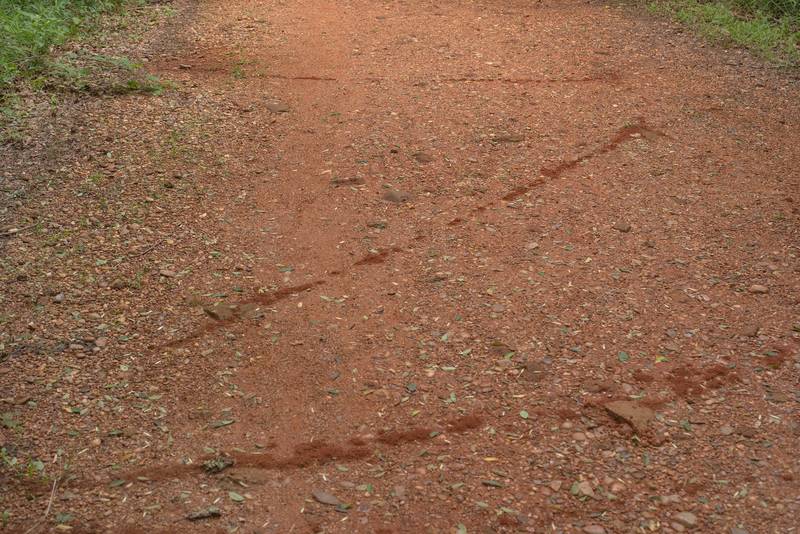

Z-shaped ant burrows after a rain on sandy path of Iron Bridge Trail in Lick Creek ParkLick Creek: Background Notes. College Station, Texas


Album 3143: Sam Houston Forest - College Station, Texas, May 1 - 2, 2022
The image captures a sandy trail at Lick Creek Park in College Station, Texas, following a rain shower that has exposed Z-shaped ant burrows on its path. The sandy trail is covered with small leaves and grass, revealing two parallel lines of dirt where ants have dug out pathways for their colony to traverse. The trail stretches from the top left corner to the bottom right corner of the image.
The image provides a detailed view of the intricate networks that ants construct using their powerful mandibles and legs. These burrows serve as vital infrastructure for ant colonies, enabling them to navigate complex underground tunnel systems while minimizing their exposure to external threats and predators. The presence of these Z-shaped burrows on the sandy trail underscores the importance of ants' engineering prowess in shaping their ecological niches.
In conclusion, this image offers a fascinating glimpse into the intricate social structures and survival strategies employed by ants, highlighting their remarkable ability to adapt to various environments through innovative underground architecture. – AI vision
🇪🇸 Descripción en español / Spanish Description
En el camino arenoso de Iron Bridge Trail en Lick Creek Park, se pueden observar madrigueras de hormigas con forma de Z después de una lluvia. College Station, Texas, 2 de mayo de 2022. La imagen captura un camino arenoso en el Parque Lick Creek en College Station, Texas, tras una ducha de agua que ha dejado al descubierto madrigueras de hormigas con forma de Z en su recorrido. El camino arenoso está cubierto de pequeñas hojas y hierba, revelando dos líneas paralelas de tierra donde las hormigas han excavado sendas para que su colonia pueda desplazarse por ellas. El camino se extiende desde la esquina superior izquierda hasta la inferior derecha de la imagen. La imagen ofrece una vista detallada de las intrincadas redes que construyen las hormigas con sus poderosos dientes y patas. Estas madrigueras son vitales para las colonias de hormigas, lo que les permite moverse por complejos sistemas de túneles subterráneos mientras minimizan su exposición a amenazas externas y depredadores. La presencia de estas madrigueras con forma de Z en el camino arenoso destaca la importancia del ingenio de las hormigas en modelar sus nichos ecológicos. En conclusión, esta imagen ofrece un fascinante vistazo a las intrincadas estructuras sociales y estrategias de supervivencia empleadas por las hormigas, resaltando su notable capacidad para adaptarse a distintos entornos mediante innovadoras arquitecturas subterráneas. – Spanish translation


