
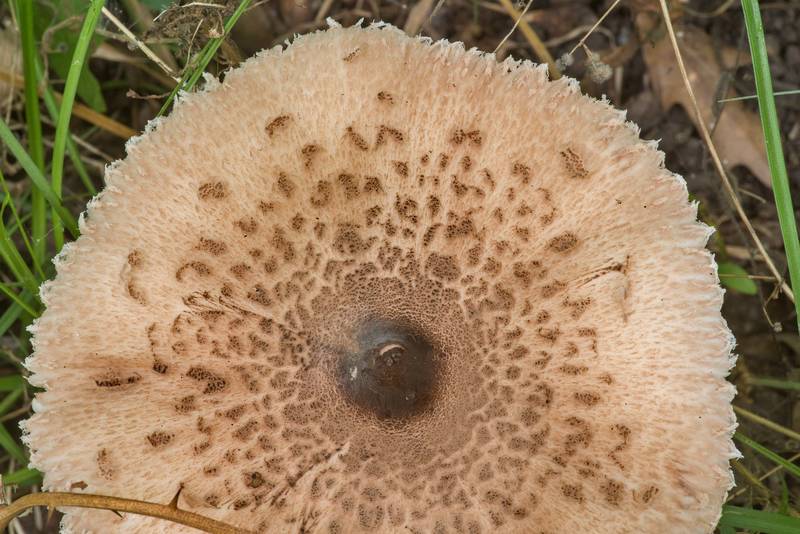

Cap of parasol mushroom (Macrolepiota procera) in Lick Creek ParkLick Creek: Background Notes. College Station, Texas


Album 3153: College Station, Texas, May 15, 2022
The image presents a close-up view of the cap of a parasol mushroom (Macrolepiota procera), situated on the ground amidst grass and other vegetation. The mushroom's cap is characterized by its large size, approximately 5-10 cm in diameter, with a slightly curved edge.
* **Cap**
* Color: Light brown to tan
* Shape: Circular to oval, with a slight curve at the edge
* Size: Approximately 5-10 cm in diameter
* Texture: Fuzzy or velvety, with small hairs covering the surface
* **Gills**
* Color: Dark brown to black
* Shape: Attachment is free from the stem and gill spacing is crowded
* Size: Approximately 1-2 cm in length
* **Stem**
* Color: White or light-colored, often with a slight yellowish tint towards the base
* Shape: Cylindrical to slightly tapering towards the top
* Size: Approximately 5-10 cm in height and 1-2 cm in width
* **Spores**
* Color: Dark brown to black
* Shape: Elliptical to oval
* Size: Approximately 6-8 micrometers in length
* **Habitat**
* Found growing on the ground in fields, meadows, and woodlands
* Often associated with grasses, wildflowers, and other vegetation
The parasol mushroom is a common and edible species found throughout much of North America. It has a distinctive appearance, with its large cap and white or light-colored stem, and can be identified by its gills, which are crowded and free from the stem. The mushroom is typically found growing on the ground in fields, meadows, and woodlands, often associated with grasses, wildflowers, and other vegetation. – AI vision
🇪🇸 Descripción en español / Spanish Description
La tapa del hongo parasol (Macrolepiota procera) en Lick Creek Park. College Station, Texas, 15 de mayo de 2022. La imagen presenta una vista detallada de la tapa del hongo parasol (Macrolepiota procera), ubicado en el suelo rodeado de hierba y otra vegetación. La cubierta del hongo se caracteriza por su gran tamaño, de aproximadamente 5-10 cm de diámetro, con un borde ligeramente curvado.
* Tapa * Color: De marrón claro a castaño oscuro * Forma: Circular a ovalada, con una ligera curva en el borde * Tamaño: Aproximadamente 5-10 cm de diámetro * Textura: Desordenada o peluda, con pequeños pelos que cubren la superficie * Gillos * Color: De marrón oscuro a negro * Forma: Fijación libre del tallo y espaciamiento de las mallas agrupadas * Tamaño: Aproximadamente 1-2 cm de largo * Tallos * Color: Blanco o ligeramente amarillento hacia la base * Forma: Cilíndrico a ligeramente estrechado hacia arriba * Tamaño: Aproximadamente 5-10 cm de altura y 1-2 cm de ancho * Esclerocios * Color: De marrón oscuro a negro * Forma: Elíptica a ovalada * Tamaño: Aproximadamente 6-8 micrómetros de largo * Hábitat * Se encuentra creciendo en el suelo en campos, praderas y bosques * A menudo asociado con hierbas, flores silvestres y otra vegetación. El hongo parasol es una especie común y comestible que se encuentra en gran parte de América del Norte. Tiene un aspecto distintivo, con su tapa grande y el tallo blanco o de color claro, y puede ser identificado por sus gillos, agrupados y sin fijación al tallo. El hongo se encuentra generalmente creciendo en el suelo en campos, praderas y bosques, a menudo asociado con hierbas, flores silvestres y otra vegetación. – Spanish translation


