
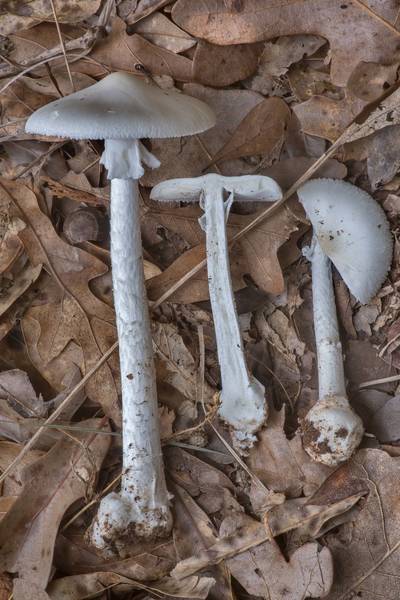

Cross section of Destroying Angel mushrooms (Amanita bisporigera) in Lick Creek ParkLick Creek: Background Notes. College Station, Texas


Album 3154: College Station, Texas, May 16 - 17, 2022
The image presents a cross-section view of three Destroying Angel mushrooms, specifically Amanita bisporigera, situated on the forest floor within Lick Creek Park in College Station, Texas. The photograph was taken on May 17, 2022.
Upon examination, it becomes apparent that the mushroom's cap is white and appears to be partially broken off from its base. In contrast, the stem is predominantly white, with a subtle brownish hue at its base. Notably, the gills underneath the cap are absent or appear to have been destroyed, likely due to an insect infestation. The cap itself features a delicate fringe of tiny hairs along its edge.
The mushroom's growth environment can be inferred from the surrounding foliage, which consists primarily of dry leaves and twigs. This suggests that the mushrooms may have grown in a relatively shaded area with limited sunlight penetration. The overall atmosphere of the image implies a late spring or early summer setting, given the presence of dry leaves and the white coloration of the mushroom's cap.
In summary, this photograph showcases three Destroying Angel mushrooms (Amanita bisporigera) in various states of development, highlighting their unique characteristics and growth environment. – AI vision
🇪🇸 Descripción en español / Spanish Description
Sección transversal de hongos Destroying Angel (Amanita bisporigera) en Lick Creek Park. College Station, Texas, 17 de mayo de 2022. La imagen presenta una vista en sección transversal de tres hongos Destroying Angel, específicamente Amanita bisporigera, situados sobre el suelo del bosque dentro del Lick Creek Park en College Station, Texas. La fotografía fue tomada el 17 de mayo de 2022. Al examinarlo, se vuelve evidente que la tapa del hongo es blanca y parece estar parcialmente rota de su base. Por el contrario, el tallo es predominantemente blanco, con un matiz marronáceo en su base. Cabe señalar que las plumas debajo de la tapa están ausentes o parecen haber sido destruidas, probablemente debido a una infestación de insectos. La propia tapa presenta un delicado borde de pequeños pelos a lo largo de su borde. El entorno de crecimiento del hongo puede inferirse a partir del follaje circundante, que consiste principalmente en hojas secas y ramitas. Esto sugiere que los hongos pueden haber crecido en un área relativamente sombreada con limitada penetración de luz solar. La atmósfera general de la imagen implica un escenario de finales de primavera o principios del verano, dada la presencia de hojas secas y la coloración blanca de la tapa del hongo. En resumen, esta fotografía muestra tres hongos Destroying Angel (Amanita bisporigera) en diversos estados de desarrollo, destacando sus características únicas y el entorno de crecimiento. – Spanish translation


