
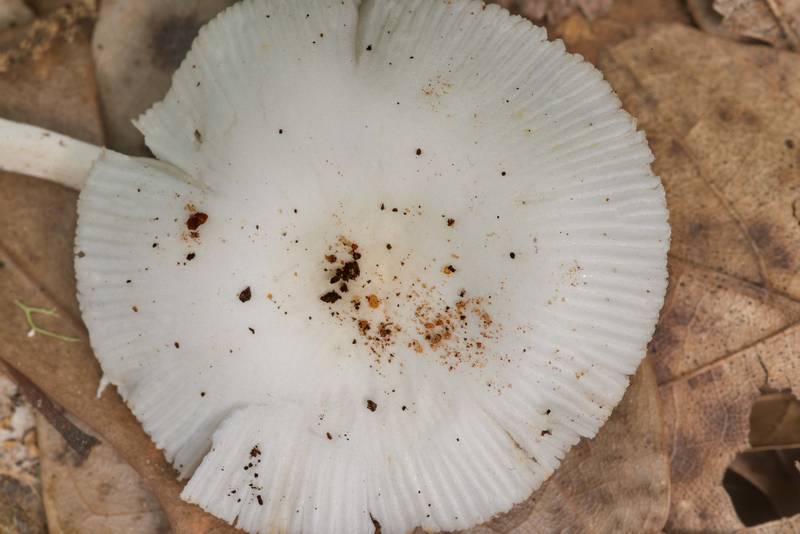

Cap of some Amanita(?) mushroom in Lick Creek ParkLick Creek: Background Notes. College Station, Texas


Album 3154: College Station, Texas, May 16 - 17, 2022
The image presents a close-up view of the cap of an Amanita mushroom situated on the forest floor amidst brown leaves and twigs. The mushroom's white cap exhibits a smooth texture with a slightly wavy edge, featuring a slight discoloration around the center that could be indicative of age or environmental factors.
A thin, pale-colored stem emerges from the underside of the cap, while a small portion of the gills is visible along the edge of the cap. These characteristics are typical of various Amanita species but may not be sufficient for identification without further analysis of the overall structure and features.
The mushroom's size is not explicitly stated in the image, although it appears to be relatively large compared to other objects on the forest floor. The setting is a natural environment with fallen leaves and twigs scattered about, suggesting that the mushroom has recently dropped from a nearby tree or plant.
In conclusion, the image provides a detailed view of an Amanita mushroom's cap, highlighting its unique characteristics and features. While the exact species cannot be determined solely based on this image, it serves as a valuable resource for identifying similar mushrooms in the future. – AI vision
🇪🇸 Descripción en español / Spanish Description
La tapa de algún hongo amanita (?) en el Lick Creek Park. College Station, Texas, 17 de mayo de 2022. La imagen presenta una vista en primer plano de la tapa de un hongo amanita situado en el suelo del bosque entre las hojas marrones y ramitas. La tapa blanca del hongo muestra una textura lisa con un borde ligeramente ondulado, que presenta una ligera descoloración alrededor del centro que podría ser indicativa de la edad o factores ambientales. Un tallo de color pálido emerge desde la parte inferior de la tapa, mientras que una pequeña porción de las láminas es visible a lo largo del borde de la tapa. Estas características son típicas de varias especies de amanita pero pueden no ser suficientes para la identificación sin un análisis adicional de la estructura y características generales. El tamaño del hongo no se especifica en la imagen, aunque parece ser relativamente grande en comparación con otros objetos en el suelo del bosque. El entorno es un ambiente natural con hojas caídas y ramitas esparcidas, lo que sugiere que el hongo ha caído recientemente desde un árbol o planta cercana. En conclusión, la imagen proporciona una vista detallada de la tapa del hongo amanita, destacando sus características y rasgos únicos. Aunque la especie exacta no se puede determinar solo con esta imagen, sirve como un recurso valioso para identificar hongos similares en el futuro. – Spanish translation


