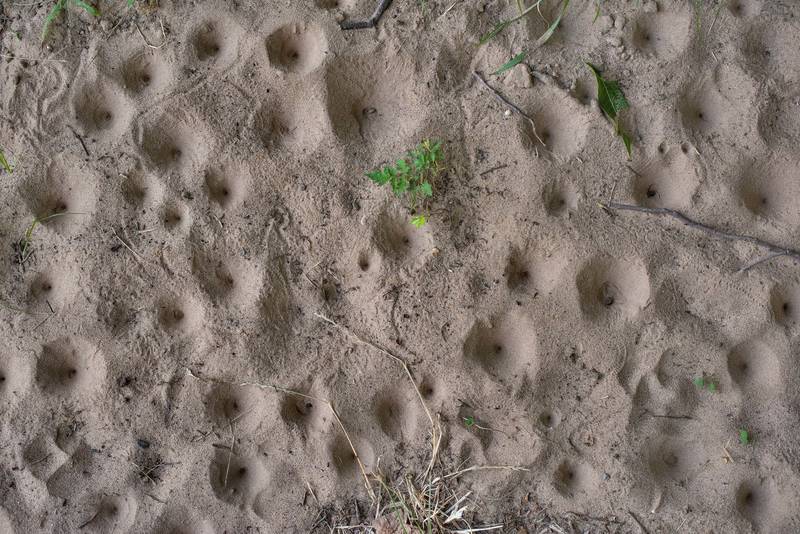

Antlion (doodlebug) funnel pits in sand in Washington-on-the-Brazos State Historic Site. Washington, Texas


Album 3179: Washington-on-the-Brazos, Texas, June 20, 2022
The image shows an area of sandy ground covered with small holes and grooves that appear to be made by ants or other burrowing insects. The sand is light brown and has a rough texture, with some small twigs and leaves scattered on its surface.
**Key Features:**
* **Holes:** Small depressions in the sand, ranging from 1/4 inch to 3/8 inch in diameter.
* **Grooves:** A series of shallow channels or grooves that radiate outward from each hole.
* **Surface Texture:** The sand has a rough texture with some small twigs and leaves scattered on its surface.
**Possible Explanation:**
The image appears to show the digging activities of ants, which are known to create complex networks of tunnels and chambers beneath the soil surface. However, it is also possible that other burrowing insects or animals, such as beetles, moths, or small mammals, may have created these holes and grooves.
**Conclusion:**
The image provides a detailed view of the digging activities of ants and possibly other burrowing insects, highlighting their ability to shape and modify their environment through excavation. The presence of twigs and leaves on the surface suggests that this area may be a habitat for various small animals or insects. – AI vision
🇪🇸 Descripción en español / Spanish Description
El antlion (doodlebug) hace pozos de arena en el sitio histórico del estado de Washington-on-the-Brazos. Washington, Texas, 20 de junio de 2022. La imagen muestra una área de suelo arenoso cubierta con pequeños agujeros y ranuras que parecen estar hechos por hormigas u otros insectos perforadores. La arena es parda clara y tiene una textura áspera, con algunos pequeños ramitos y hojas esparcidos en su superficie. **Características clave:** * **Hoyos:** Depresiones pequeñas en la arena, que van desde 1/4 de pulgada a 3/8 de pulgada de diámetro. * **Surcos:** Una serie de canales o surcos poco profundos que se irradian hacia afuera desde cada agujero. * **Textura superficial:** La arena tiene una textura áspera con algunos pequeños ramitos y hojas esparcidos en su superficie. **Posible explicación:** La imagen muestra las actividades de excavación de hormigas, que son conocidas por crear complejas redes de túneles y cámaras bajo la superficie del suelo. Sin embargo, también es posible que otros insectos o animales perforadores, como escarabajos, polillas u pequeños mamíferos, hayan creado estos agujeros y surcos. **Conclusión:** La imagen proporciona una vista detallada de las actividades de excavación de hormigas y posiblemente otros insectos perforadores, destacando su capacidad para dar forma y modificar su entorno a través de la excavación. La presencia de ramitas y hojas en la superficie sugiere que esta área puede ser un hábitat para varios pequeños animales o insectos. – Spanish translation