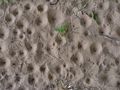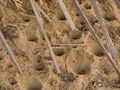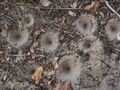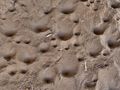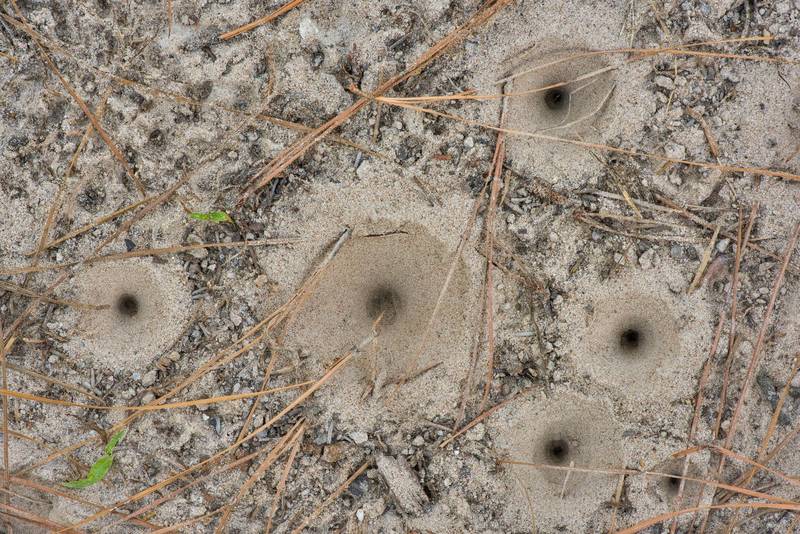

Antlion (doodlebug) funnel pits on Forest Service Rd. 203 near Richards Loop Trail in Sam Houston National Forest. Texas


Album 3197: Sam Houston Forest, Texas, July 26 - 26, 2022
The image depicts a sandy surface with several small holes scattered across it. These holes are likely to be funnels created by antlions, also known as doodlebugs. Antlions are insects that feed on ants and other small insects. They have distinctive funnel-shaped pits in the sand where they lie in wait for prey to fall into.
In the image, there are at least six funnel pits visible. The largest one is located near the center of the image, while smaller ones are scattered around it. Some of these funnels appear to be quite deep, suggesting that they have been used recently by an antlion.
The surrounding area appears to be a sandy trail or road, possibly within a forested region given the mention of Sam Houston National Forest in the caption. The presence of dry leaves and twigs nearby suggests that this is not a typical urban environment but rather a more natural setting where wildlife can thrive.
Overall, the image provides a unique glimpse into the behavior of antlions and their habitat preferences. It highlights how these insects adapt to sandy surfaces to catch prey, making them an interesting subject for study in ecology and entomology. – AI vision
🇪🇸 Descripción en español / Spanish Description
El día 28 de julio de 2022, en el bosque nacional Sam Houston, Texas, se encuentran fosas de hormigas ardillas (antlion) en la carretera del Servicio Forestal 203 cerca del sendero Richards Loop. La imagen muestra una superficie arenosa con varios agujeros pequeños dispersos por toda ella. Es probable que estos agujeros sean fosas creadas por hormigas ardillas, también conocidas como doodlebugs. Las hormigas ardillas son insectos que se alimentan de hormigas y otros pequeños insectos. Tienen fosas en forma de embudo visibles en la arena donde esperan a sus presas para que caigan dentro. En la imagen, hay al menos seis fosas visibles. La más grande está ubicada cerca del centro de la imagen, mientras que las más pequeñas están dispersas alrededor de ella. Algunas de estas fosas parecen ser bastante profundas, lo que sugiere que han sido recientemente utilizadas por una hormiga ardilla. El área circundante parece ser un camino o carretera arenosa, posiblemente dentro de una región boscosa, dado el nombre del bosque nacional Sam Houston en la leyenda. La presencia de hojas secas y ramitas cerca sugiere que no se trata de un entorno urbano típico, sino más bien un escenario natural donde la vida silvestre puede prosperar. En general, la imagen ofrece una visión única del comportamiento de las hormigas ardillas y sus preferencias de hábitat. Destaca cómo estos insectos se adaptan a superficies arenosas para capturar presas, lo que los convierte en un tema interesante de estudio en ecología e entomología. – Spanish translation