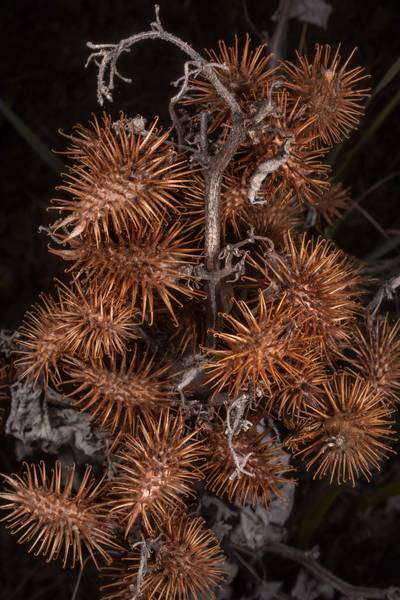

Seeds of cocklebur (Xanthium strumarium) in Lick Creek ParkLick Creek: Background Notes. College Station, Texas


Album 3180: College Station - Sam Houston Forest, Texas, June 21 - 23, 2022
The image depicts seeds of the cocklebur plant (Xanthium strumarium), a common weed found in many parts of North America. The seeds are clustered together and appear to be attached to a thin stem or branch.
Each seed is approximately 1-2 cm long and has a distinctive shape, with several sharp, barbed spikes protruding from its surface. These spikes are likely responsible for the plant's ability to cling to clothing and animal fur, allowing it to disperse its seeds over long distances.
The background of the image appears to be dark and shadowy, suggesting that the photo was taken in a shaded area or at night. The overall effect is one of stark contrast between the bright, spiny seeds and the dull, muted tones of the surrounding environment.
Overall, the image provides a detailed view of the cocklebur seed, highlighting its unique features and adaptations for dispersal. It may be useful for botanists, ecologists, or anyone interested in learning more about this common weed. – AI vision
🇪🇸 Descripción en español / Spanish Description
Semillas de hiedra venenosa (Xanthium strumarium) en Lick Creek Park. College Station, Texas, 22 de junio de 2022. La imagen representa las semillas de la planta hiedra venenosa (Xanthium strumarium), una mala hierba común encontrada en muchas partes de Norteamérica. Las semillas están agrupadas y parecen estar unidas a un tallo delgado o rama. Cada semilla mide aproximadamente 1-2 cm de largo y tiene una forma distintiva, con varios picos arpones afilados sobresaliendo de su superficie. Es probable que estos picos sean responsables de la capacidad de la planta para agarrarse a la ropa y el pelaje de los animales, permitiéndole dispersar sus semillas a largas distancias. El fondo de la imagen parece oscuro y sombrío, lo que sugiere que la foto fue tomada en un área con sombra o de noche. El efecto general es el de un fuerte contraste entre las semillas brillantes y espinosas y los tonos opacos del entorno circundante. En general, la imagen proporciona una vista detallada de la semilla de hiedra venenosa, destacando sus características únicas y adaptaciones para su dispersión. Puede ser útil para boticarios, ecólogos o cualquiera que esté interesado en aprender más sobre esta mala hierba común. – Spanish translation