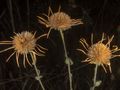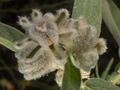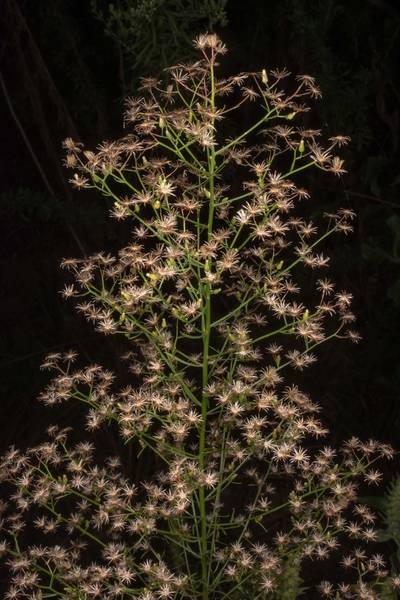

Horseweed(?) with seeds in Lick Creek ParkLick Creek: Background Notes. College Station, Texas


Album 3258: College Station - Lake Somerville, Texas, October 10 - 12, 2022
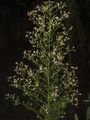
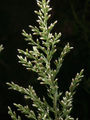
The image depicts a plant with small white flowers and green stems against a dark background. The plant appears to be horseweed (Conyza canadensis), which is common throughout much of North America. It has been known by many names over time including Canada Fleabane, Canadian Horseweed, and False Ragweed.
Horseweed is an annual or short-lived perennial in the Asteraceae family that grows 2 to 10 feet tall with a stem that is square in cross-section. The leaves are lance-shaped, toothed at the tip, and arranged oppositely on the stem. At the top of each plant, there is a flower head composed of many tiny florets. Each individual flower has five white petals, giving the appearance of being made up of hundreds of small flowers.
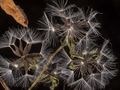
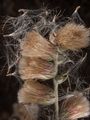
When mature, the seeds are dispersed by wind and water. Horseweed can be found growing in fields, meadows, along roadsides, and in disturbed areas. It is considered a weed because it competes with crops for water, nutrients, and light, and its seed heads can produce up to 15,000 seeds per plant.
Horseweed has been used as medicine for centuries to treat ailments such as fever, rheumatism, and colds. The leaves and stems contain flavonoids, saponins, and other compounds that have anti-inflammatory properties. Additionally, horseweed has been shown to have antiviral activity against certain viruses.
In terms of its ecological role, horseweed provides food for various insects like bees, butterflies, and moths. Its flowers are also an important source of nectar for pollinators. Horseweed is considered a valuable plant due to its medicinal properties, as well as its ability to attract beneficial insects. – AI vision
🇪🇸 Descripción en español / Spanish Description
El "malva sylvestre" con semillas en Lick Creek Park. College Station, Texas, 10 de octubre del 2022. La imagen muestra una planta con pequeñas flores blancas y tallos verdes sobre un fondo oscuro. Se cree que es malva sylvestre (Conyza canadensis), que se encuentra en gran parte de Norteamérica. Ha sido conocido por muchos nombres a lo largo del tiempo, como "Canada Fleabane", "Horseweed canadiense" y "False Ragweed". La malva sylvestre es una planta anual o perenne de vida corta en la familia Asteraceae que mide entre 2 y 10 pies de altura con un tallo cuadrado en sección transversal. Las hojas son lanceoladas, dentadas en la punta y dispuestas opuestamente en el tallo. En la cima de cada planta hay una cabeza floral compuesta por muchos flores minúsculas. Cada flor individual tiene cinco pétalos blancos, dando la apariencia de estar hecha de cientos de pequeñas flores. Cuando están maduros, los semillas se dispersan por el viento y el agua. La malva sylvestre puede crecer en campos, praderas, junto a carreteras y en zonas perturbadas. Se considera una mala hierba porque compite con cultivos por agua, nutrientes y luz, y sus cabezas florales pueden producir hasta 15.000 semillas por planta. La malva sylvestre se ha utilizado como medicina durante siglos para tratar dolencias como la fiebre, el reumatismo y los resfriados. Las hojas y tallos contienen flavonoides, saponinas y otros compuestos que tienen propiedades antiinflamatorias. Además, se ha demostrado que la malva sylvestre tiene actividad antiviral contra ciertos virus. En términos de su función ecológica, la malva sylvestre sirve de alimento para diversos insectos como abejas, mariposas y polillas. Sus flores también son una importante fuente de néctar para polinizadores. La malva sylvestre es considerada una planta valiosa debido a sus propiedades medicinales, así como su capacidad de atraer insectos beneficiosos. – Spanish translation