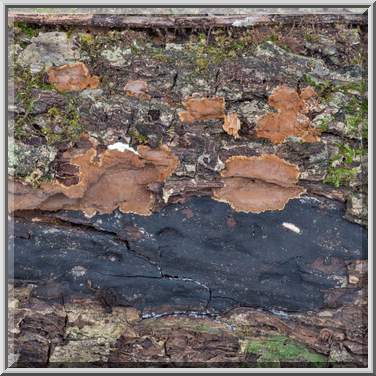

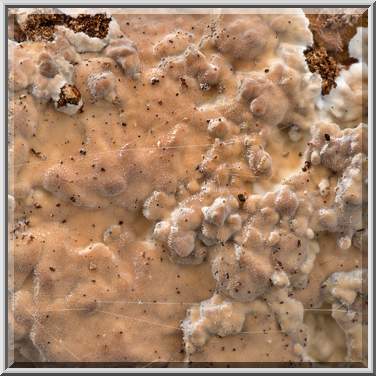
Close-up of corticioid fungus Scytinostroma portentosum(?) on a dry stem of pecan in Lick Creek ParkLick Creek: Background Notes. College Station, Texas


Album 3316: Mushrooms in Lick Creek Park, College Station, Texas, January 2, 2023
The image presents a close-up view of a corticioid fungus, specifically Scytinostroma portentosum(?), growing on the dry stem of a pecan tree in Lick Creek Park, College Station, Texas. The photograph was taken on January 2, 2023.
**Fungus**
* **Color:** The fungus exhibits a light brown to tan color with white patches scattered throughout.
* **Texture:** Its surface appears rough and irregular, featuring small, rounded protrusions that resemble tiny bumps or nodules.
**Background**
* **Stem of Pecan Tree:** The background of the image features a dry stem of a pecan tree. It is light brown in color with visible cracks and fissures.
* **Cracks and Fissures:** Scattered throughout the stem are small cracks and fissures, which may be caused by drying or environmental factors.
**Overall**
The image provides a detailed view of the corticioid fungus Scytinostroma portentosum(?), highlighting its unique characteristics and growth pattern on the dry stem of a pecan tree. The photograph offers valuable insights into the morphology and habitat of this species, contributing to our understanding of fungal diversity and ecology. – AI vision
🇪🇸 Descripción en español / Spanish Description
En primer plano del hongo corticío Scytinostroma portentosum (?) en un tallo seco de pecán en Lick Creek Park. College Station, Texas, 2 de enero de 2023. La imagen presenta una vista en primer plano de un hongo corticío, específicamente Scytinostroma portentosum (?), creciendo en el tallo seco de un árbol de pecán en Lick Creek Park, College Station, Texas. La fotografía fue tomada el 2 de enero de 2023. **Hongo** * **Color:** El hongo exhibe un color marrón claro a beis con manchas blancas dispersadas por todo. * **Textura:** Su superficie aparece rugosa e irregular, con pequeñas protuberancias redondeadas que se asemejan a pequeños bultos o nódulos. **Antecedentes** * **Tallo de árbol de Pecán:** El fondo de la imagen muestra un tallo seco de un árbol de pecán. Es de color marrón claro con grietas y fisuras visibles. * **Grietas y Fisuras:** Dispersadas por todo el tallo hay pequeñas grietas y fisuras, que pueden ser causadas por el secado o factores ambientales. **En general** La imagen proporciona una vista detallada del hongo corticío Scytinostroma portentosum (?), destacando sus características únicas y su patrón de crecimiento en el tallo seco de un árbol de pecán. La fotografía ofrece insights valiosos sobre la morfología y hábitat de esta especie, contribuyendo a nuestra comprensión de la diversidad y ecología fúngica. – Spanish translation


