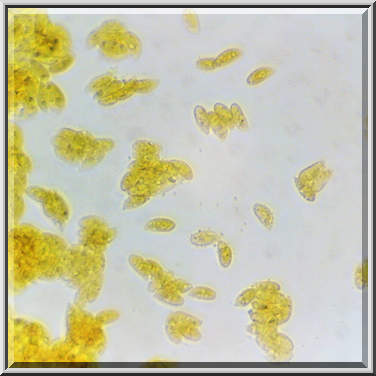
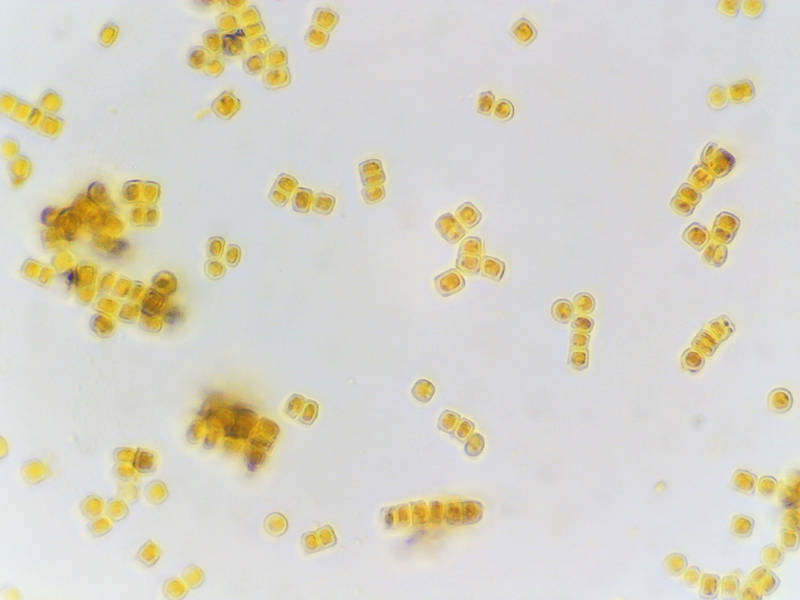
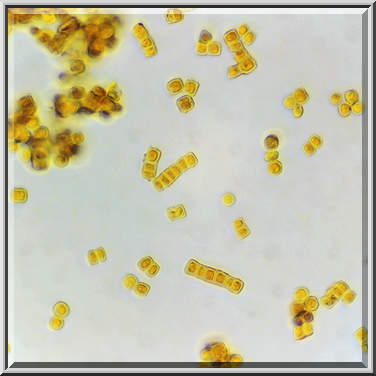
Chain of cubical conidia of soft yellowish mold-like fungus from underside of a broadleaf log, may be Arthroconidium, Coremiella cubispora or Wallemia, collected a day before in Lick Creek ParkLick Creek: Background Notes. College Station, Texas


Album 3325: College Station - Sam Houston Forest, Texas, January 10 - 12, 2023
The image shows a microscopic examination of fungal spores on a glass slide. The background is white and appears to be either glass or a microscope slide, with a small border around it at the bottom.
In the center of the image, there are numerous tiny yellowish-brown objects that resemble small rectangular bricks in chain formation. These structures appear to be conidia (spores) from various types of fungi. The spores are likely cubical or square and have two or four walls. They vary in size but generally measure about 2-4 micrometers across.
The image suggests that the fungal sample was collected from a broadleaf log on January 9, 2023.
Based on the description provided by the person who submitted this image to iNaturalist, the conidia could belong to one of three species:
1) Arthroconidium
2) Coremiella cubispora
3) Wallemia
Arthroconidium is a genus of fungi in the family Microascaceae. Members of this genus are commonly known as arthrodial fungi and produce conidia that resemble small, square or rectangular bricks. They can be found on various substrates such as decaying plant material.
Coremiella cubispora is a species of fungus in the family Coremiellaceae. It produces brownish-yellow spores that have two to four walls and are typically 2-4 micrometers across. This species has been reported to grow on dead leaves, stems, or branches of trees.
Wallemia is another genus of fungi that includes the type species W. sebi, which was first described in 1836 by Wallem. Members of this genus produce brownish-yellow spores with two or four walls and are typically 2-4 micrometers across. They can be found on decaying plant material or soil.
In conclusion, while it is difficult to determine the exact species based solely on a microscopic image, the conidia described in the image appear to match those of Arthroconidium, Coremiella cubispora, or Wallemia. Further examination and analysis would be necessary to confirm the identity of these fungi. – AI vision
🇪🇸 Descripción en español / Spanish Description
Cadena de conidios cúbicos de un hongo blando y con aspecto de moho amarillento, que podrían ser Arthroconidium, Coremiella cubispora o Wallemia, recogidos un día antes en el Lick Creek Park. College Station, Texas, 10 de enero del 2023. La imagen muestra una inspección microscópica de esporas fúngicas sobre un portaobjetos de vidrio. El fondo es blanco y parece ser o bien de vidrio o un portaobjetos de microscopio, con un pequeño borde alrededor en la parte inferior. En el centro de la imagen hay numerosos objetos amarillentos-marrón que se asemejan a pequeños ladrillos rectangulares en formación de cadena. Estas estructuras parecen ser conidios (esporas) de diferentes tipos de hongos. Los conidios son probablemente cúbicos o cuadrados y tienen dos o cuatro paredes. Varian en tamaño pero generalmente miden alrededor de 2-4 micrómetros de diámetro. La imagen sugiere que la muestra fúngica se recolectó de un tronco de hoja ancha el 9 de enero del 2023. Basándose en la descripción proporcionada por la persona que envió esta imagen a iNaturalist, los conidios podrían pertenecer a una de las tres especies: 1) Arthroconidium 2) Coremiella cubispora 3) Wallemia. Arthroconidium es un género de hongos en la familia Microascaceae. Los miembros de este género se conocen comúnmente como hongos artrodiales y producen conidios que recuerdan pequeños ladrillos rectangulares o cuadrados. Se pueden encontrar en varias superficies, como el material vegetal en descomposición. Coremiella cubispora es una especie de hongo en la familia Coremiellaceae. Produce esporas pardusco-amarronadas con dos a cuatro paredes y típicamente miden 2-4 micrómetros de diámetro. Esta especie se ha informado que crece sobre hojas, tallos o ramas muertas de árboles. Wallemia es otro género de hongos que incluye la especie W. Sebi, descrita por primera vez en 1836 por Wallem. Los miembros de este género producen esporas pardusco-amarronadas con dos a cuatro paredes y típicamente miden 2-4 micrómetros de diámetro. Se pueden encontrar sobre material vegetal en descomposición o suelo. En conclusión, aunque es difícil determinar la especie exacta basándose únicamente en una imagen microscópica, los conidios descritos en la imagen parecen corresponder a Arthroconidium, Coremiella cubispora o Wallemia. Se necesitarían un análisis y examen adicionales para confirmar la identidad de estos hongos. – Spanish translation


