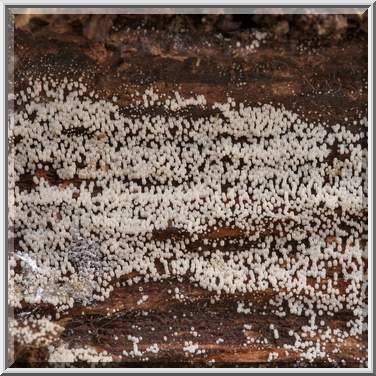

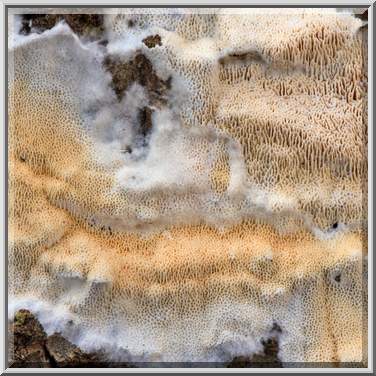
Cream colored resupinate polypore mushroom on a broadleaf log in Lick Creek ParkLick Creek: Background Notes. College Station, Texas


Album 3327: College Station, Texas, January 14 - 15, 2023
This image features a close-up photograph of a cream-colored resupinate polypore mushroom growing on the underside of a broadleaf log, likely from a hardwood tree.
The upper left corner of the photo shows part of the log. The wood grain is visible in this area and has darkened to gray-brown color with age or weathering. The remaining portion of the image showcases the resupinate polypore mushroom covering the log surface.
This type of fungus grows flat on the ground, decaying logs, or tree trunks. The white mycelium is visible in the cracks and crevices of the wood grain where it has begun to break down. This mycelium creates a sponge-like appearance, with pores that resemble tiny holes.
The coloration of this particular specimen is unique among resupinate polypores. Most are tan or grayish-brown in color. The cream-colored variety may be rare or not well-documented, which could explain why it was discovered by the photographer in Lick Creek Park and photographed on January 15th, 2023.
The presence of this mushroom on a broadleaf log suggests that it is likely to be a species of Ganoderma, commonly found on hardwood trees. Further research would be necessary to confirm the exact identity of this specimen. – AI vision
🇪🇸 Descripción en español / Spanish Description
Un hongo resupinado poliporo de color crema sobre un tronco de hoja ancha en el Lick Creek Park. College Station, Texas, enero 15, 2023. Esta imagen muestra una fotografía detallada de un hongo resupinado poliporo de color crema que crece en la parte inferior de un tronco de hoja ancha, probablemente de un árbol de madera dura. En el ángulo superior izquierdo de la foto se muestra parte del tronco. El grano de la madera es visible en esta área y se ha oscurecido a un color marrón grisáceo con la edad o intemperie. La parte restante de la imagen presenta el hongo resupinado poliporo que cubre la superficie del tronco. Este tipo de hongos crecen planos en el suelo, troncos podridos o árboles. El mycelio blanco es visible en las grietas y hendiduras del grano de la madera donde ha comenzado a descomponerse. Este mycelio crea un aspecto similar a una esponja, con poros que parecen pequeños orificios. La coloración de esta muestra particular es única entre los hongos resupinados. La mayoría son de color canela o grisáceo. La variedad de color crema puede ser rara o no bien documentada, lo que podría explicar por qué fue descubierta por el fotógrafo en Lick Creek Park y fotografiada el 15 de enero de 2023. La presencia de este hongo en un tronco de hoja ancha sugiere que es probable que sea una especie de Ganoderma, comúnmente encontrado en árboles de madera dura. Se necesitaría más investigación para confirmar la identidad exacta de esta muestra. – Spanish translation


