
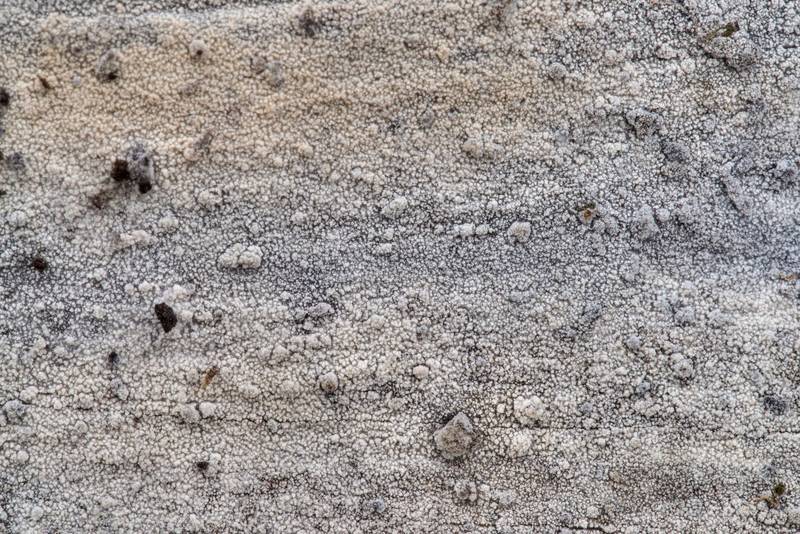

Close-up of white powdery corticioid fungus on a fallen tree (pine or oak) at the bottom of Toad Pond near Roosevelt Cutoff Trail in Bastrop State Park. Bastrop, Texas


Album 3331: Bastrop, Texas, January 21, 2023
The image depicts a close-up view of white powdery corticioid fungus on a fallen tree (pine or oak) at the bottom of Toad Pond near Roosevelt Cutoff Trail in Bastrop State Park. The fallen tree is likely a deciduous species such as oak, based on the color and texture of the bark.
The white powdery growths are likely caused by a corticioid fungus, which are fungi that grow on dead or dying wood. Corticioid fungi often have a powdery or crust-like appearance due to their ability to break down the lignin in plant cell walls. The presence of these fungi suggests that the tree has been dead for some time and is now being decomposed by microorganisms.
The image provides a detailed view of the fungal growths, which are scattered across the surface of the tree trunk. The fungus appears to be growing on both sides of the bark, with more prominent growths found near the top of the image. The texture of the fungus is rough and irregular, suggesting that it has been growing for some time.
Overall, the image provides a fascinating glimpse into the process of decomposition and the role that fungi play in breaking down dead plant material. – AI vision
🇪🇸 Descripción en español / Spanish Description
Primer plano de hongos corticiales blanquecinos en un árbol caído (pino o roble) en el fondo del charco de sapos cerca del sendero Roosevelt Cutoff en el parque estatal de Bastrop. Bastrop, Texas, 21 de enero de 2023. La imagen muestra una vista detallada de los hongos corticiales blanquecinos en un árbol caído (pino o roble) en el fondo del charco de sapos cerca del sendero Roosevelt Cutoff en el parque estatal de Bastrop. El árbol caído es probablemente una especie de hoja caduca, como el roble, basado en el color y textura de la corteza. Los crecimientos blanquecinos son probablemente causados por un hongo corticial, que son hongos que crecen en madera muerta o en proceso de muerte. Los hongos corticiales a menudo tienen una apariencia pulverulenta o similar a costra debido a su capacidad para descomponer la lignina en las paredes celulares de las plantas. La presencia de estos hongos sugiere que el árbol ha estado muerto durante algún tiempo y ahora está siendo descompuesto por microorganismos. Las imágenes proporcionan una vista detallada del crecimiento fúngico, que se dispersa por la superficie del tronco del árbol. El hongo parece estar creciendo en ambos lados de la corteza, con crecimientos más prominentes encontrados cerca de la parte superior de la imagen. La textura del hongo es rugosa e irregular, lo que sugiere que ha estado creciendo durante algún tiempo. En general, la imagen proporciona un fascinante vistazo al proceso de descomposición y el papel que juegan los hongos en descomponer material vegetal muerto. – Spanish translation


