
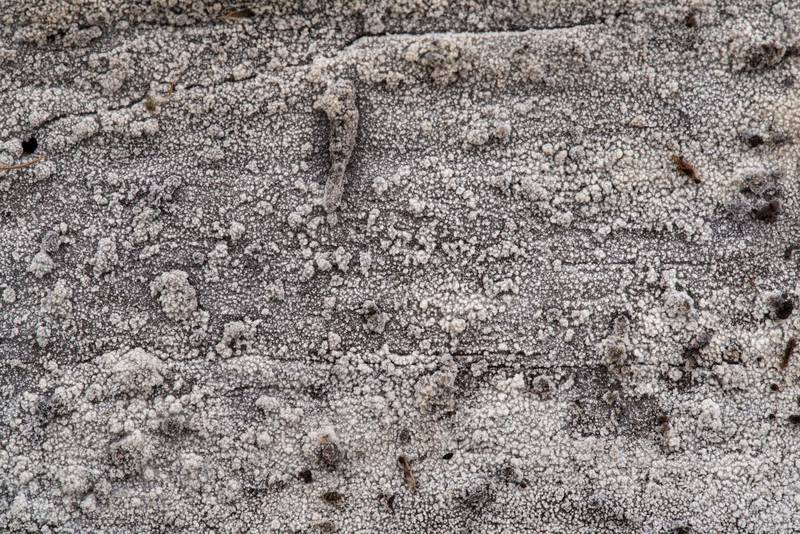

Close-up of white powdery crust fungus on a fallen tree at the bottom of Toad Pond near Roosevelt Cutoff Trail in Bastrop State Park. Bastrop, Texas


Album 3331: Bastrop, Texas, January 21, 2023
The image depicts a close-up photograph of white powdery crust fungus on a fallen tree at the bottom of Toad Pond near Roosevelt Cutoff Trail in Bastrop State Park. The subject matter is a fallen tree trunk that has been covered with a thick layer of white powdery crust fungus, which covers nearly every part of the visible surface area.
The texture of the tree bark is rough and irregular. The fungus appears to have grown on top of the tree's natural growth patterns, covering up some of its ridges and grooves, while also filling in gaps between them.
The overall appearance of this fallen tree trunk gives it a distinctive look; one that would be easily recognizable as an old or dead tree due to its age.
It is likely that this fungus has been growing on the fallen tree for quite some time now because there are no visible signs of recent damage or decay around it. This suggests that the fungus may have been present before the tree fell over, possibly even helping to weaken its structure by breaking down parts of the trunk over time.
The image shows a close-up view of what appears to be a type of lichen growing on top of the fallen tree trunk. Lichens are composite organisms consisting of fungi and algae or cyanobacteria living together in a symbiotic relationship, often with other microorganisms such as bacteria. They can grow almost anywhere, including rocks, soil, trees, buildings, and even human skin.
The image is taken from directly above the subject matter, providing an unobstructed view of the entire surface area covered by the fungus. The lighting appears to be natural daylight, illuminating both the tree trunk and the surrounding environment evenly throughout the frame without any harsh shadows or reflections that might obscure details in certain areas.
Overall, this photograph captures a fascinating example of nature's ability to reclaim abandoned spaces like fallen trees through various forms of life such as lichens. – AI vision
🇪🇸 Descripción en español / Spanish Description
Primer plano de un hongo en forma de costra polvorienta blanca sobre un árbol caído al fondo del charco de los sapos cerca del sendero Roosevelt Cutoff en el parque estatal de Bastrop. Bastrop, Texas, 21 de enero de 2023. La imagen muestra una fotografía detallada de un hongo en forma de costra polvorienta blanca sobre un árbol caído al fondo del charco de los sapos cerca del sendero Roosevelt Cutoff en el parque estatal de Bastrop. El tema es un tronco de árbol caído que ha sido cubierto con una capa gruesa de hongo en forma de costra polvorienta blanca, que cubre casi toda la superficie visible. La textura de la corteza del árbol es áspera e irregular. El hongo parece haber crecido sobre los patrones naturales de crecimiento del árbol, cubriendo algunas de sus aristas y surcos, mientras que también llena los huecos entre ellos. La apariencia general de este tronco de árbol caído le da un aspecto distintivo; uno que sería fácilmente reconocible como un árbol viejo o muerto debido a su edad. Es probable que este hongo haya crecido sobre el árbol caído durante bastante tiempo, ya que no hay signos visibles de daño reciente o descomposición alrededor del mismo. Esto sugiere que el hongo puede haber estado presente antes de que el árbol se cayera, posiblemente ayudando a debilitar su estructura al degradar partes del tronco con el tiempo. La imagen muestra una vista detallada de lo que parece ser un tipo de líquen creciendo sobre el tronco del árbol caído. Los líquenes son organismos compuestos formados por hongos y algas o cianobacterias que viven juntos en una relación simbiótica, a menudo con otros microorganismos como bacterias. Pueden crecer casi en cualquier lugar, incluidas las rocas, el suelo, los árboles, los edificios y la piel humana. La imagen se tomó directamente por encima del objeto, proporcionando una vista sin obstáculos de toda la superficie cubierta por el hongo. El aspecto lumínico parece ser luz natural, iluminando tanto el tronco del árbol como el entorno circundante uniformemente en todo el marco sin sombras o reflejos fuertes que puedan ocultar detalles en ciertas áreas. En general, esta fotografía captura un fascinante ejemplo de la capacidad de la naturaleza para recuperar espacios abandonados como árboles caídos a través de varias formas de vida como líquenes. – Spanish translation


