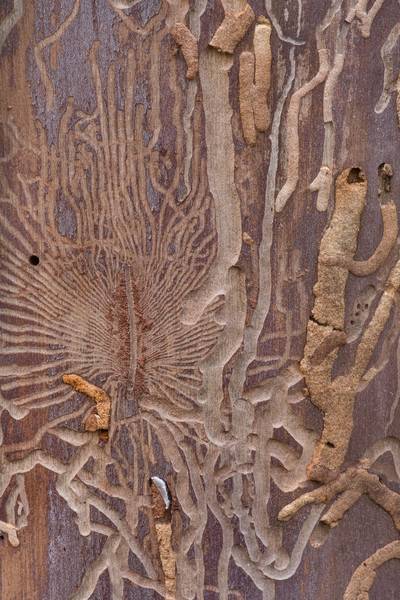

Tunnels of bark beetles on a dry standing tree in Lick Creek ParkLick Creek: Background Notes. College Station, Texas


Album 3334: College Station - Washington-on-the-Brazos, Texas, January 25 - 28, 2023
The image depicts the damage caused by bark beetles to a dry-standing tree in Lick Creek Park, College Station, Texas. The image shows the tunnels created by the beetles on the surface of the tree.
* **Tree Surface:**
* The tree surface is covered with a network of tunnels that are approximately 1-2 mm wide and extend up to several centimeters deep into the bark.
* The tunnels appear to be randomly distributed across the surface, but they tend to cluster together in certain areas.
* The edges of the tunnels are rough and irregular, suggesting that they were created by the beetles chewing through the bark rather than digging it out.
* **Bark Beetle Activity:**
* The presence of numerous small holes at the ends of the tunnels suggests that adult bark beetles have emerged from these tunnels to lay eggs or mate.
* The size and shape of the holes indicate that they were made by small insects, likely the adult bark beetles themselves rather than other animals like rodents or birds.
* **Tree Health:**
* The dry standing tree appears to be dead or dying, as evidenced by its grayish-brown color and lack of leaves.
* The presence of bark beetle tunnels may have contributed to the tree's decline by weakening its defenses against disease and insects.
Overall, the image provides a clear visual representation of the damage caused by bark beetles to a dry-standing tree in Lick Creek Park. The tunnels created by the beetles are evident on the surface of the tree, and the presence of small holes at the ends of these tunnels suggests that adult bark beetles have emerged from them to lay eggs or mate. – AI vision
🇪🇸 Descripción en español / Spanish Description
Túneles de los escarabajos de la corteza en un árbol seco en Lick Creek Park. College Station, Texas, 25 de enero de 2023. La imagen muestra el daño causado por los escarabajos de la corteza a un árbol seco en el parque Lick Creek, College Station, Texas. La imagen muestra los túneles creados por los escarabajos en la superficie del árbol. **Superficie del árbol:** * La superficie del árbol está cubierta con una red de túneles que miden aproximadamente 1-2 mm de ancho y se extienden hasta varios centímetros de profundidad en la corteza. * Los túneles parecen estar distribuidos aleatoriamente a lo largo de la superficie, pero tienden a agruparse juntos en ciertas áreas. * Los bordes de los túneles son ásperos e irregulares, lo que sugiere que fueron creados por los escarabajos masticando la corteza en lugar de cavarla. **Actividad del escarabajo de la corteza:** * La presencia de numerosos pequeños agujeros en los extremos de los túneles sugiere que han emergido adultos escarabajos de la corteza para poner huevos o aparearse. **Salud del árbol:** * El árbol seco parece estar muerto o moribundo, como evidencia su color grisáceo y la falta de hojas. * La presencia de túneles de escarabajos de la corteza puede haber contribuido al declive del árbol debilitando sus defensas contra enfermedades e insectos. En general, la imagen proporciona una representación visual clara del daño causado por los escarabajos de la corteza a un árbol seco en el parque Lick Creek. Los túneles creados por los escarabajos son evidentes en la superficie del árbol, y la presencia de pequeños agujeros en los extremos de estos túneles sugiere que han emergido adultos escarabajos de la corteza para poner huevos o aparearse. – Spanish translation