
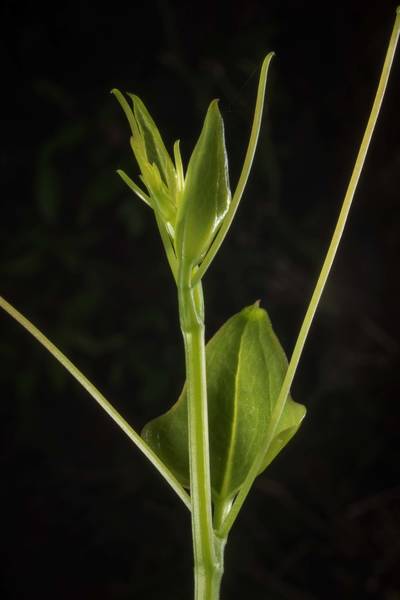

Shoot of greenbrier (Smilax) in Lick Creek ParkLick Creek: Background Notes. College Station, Texas


Album 3361: College Station, Texas, March 9 - 10, 2023
The image depicts a small shoot of greenbrier (Smilax), a type of vine native to North America and Asia, with a distinctive appearance characterized by:
* **Stem**: The stem is covered with stiff hairs that are sharp enough to cause injury. It can grow up to 30 feet long.
* **Leaves**: The leaves are lance-shaped and pointed at the tip. They have serrated edges and may be alternate or opposite on the stem.
* **Flowers**: Greenbrier flowers are small, greenish-white, and not particularly showy.
* **Fruits**: The fruit of greenbrier is a red berry that grows in clusters.
**Caption Context**
The image was taken at Lick Creek Park in College Station, Texas, on March 10, 2023. It likely appears early in the spring when new growth begins to emerge from the ground after winter dormancy. Greenbrier is known for its ability to grow rapidly and form dense thickets that can be challenging to navigate.
**Key Features**
* The image shows a small shoot of greenbrier with two or three leaves and a stem covered in stiff hairs.
* The background of the image is dark, suggesting it was taken at night or under low light conditions.
* The overall appearance of the image suggests that it may have been used to illustrate an article or blog post about gardening or botany. – AI vision
🇪🇸 Descripción en español / Spanish Description
Brote de espino cerval (Smilax) en Lick Creek Park. College Station, Texas, el 10 de marzo de 2023. La imagen representa un pequeño brote de espino cerval (Smilax), un tipo de planta trepadora nativa de América del Norte y Asia, con una apariencia distintiva caracterizada por: * **Tallo**: el tallo está cubierto de pelos rígidos lo suficientemente afilados como para provocar heridas. Puede crecer hasta 30 pies de largo. * **Hojas**: las hojas son lanceoladas y puntiagudas en la punta. Tienen bordes serrados y pueden ser alternas u opuestas en el tallo. * **Flores**: las flores del espino cerval son pequeñas, de color blanco verdoso y no particularmente vistosas. * **Frutos**: El fruto del espino cerval es una baya roja que crece en racimos. **Caption Context** La imagen se tomó en Lick Creek Park en College Station, Texas, el 10 de marzo de 2023. Es probable que aparezca temprano en la primavera cuando comienza a emerger nuevo crecimiento desde el suelo después del letargo invernal. El espino cerval se conoce por su capacidad para crecer rápidamente y formar densos matorrales que pueden ser difíciles de navegar. **Características clave** * La imagen muestra un pequeño brote de espino cerval con dos o tres hojas y un tallo cubierto de pelos rígidos. * El fondo de la imagen es oscuro, lo que sugiere que se tomó de noche o en condiciones de poca luz. * La apariencia general de la imagen sugiere que podría haberse utilizado para ilustrar un artículo o publicación sobre jardinería o botánica. – Spanish translation


