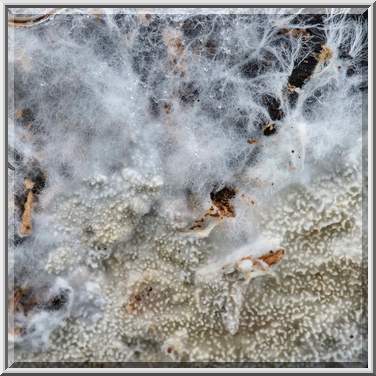
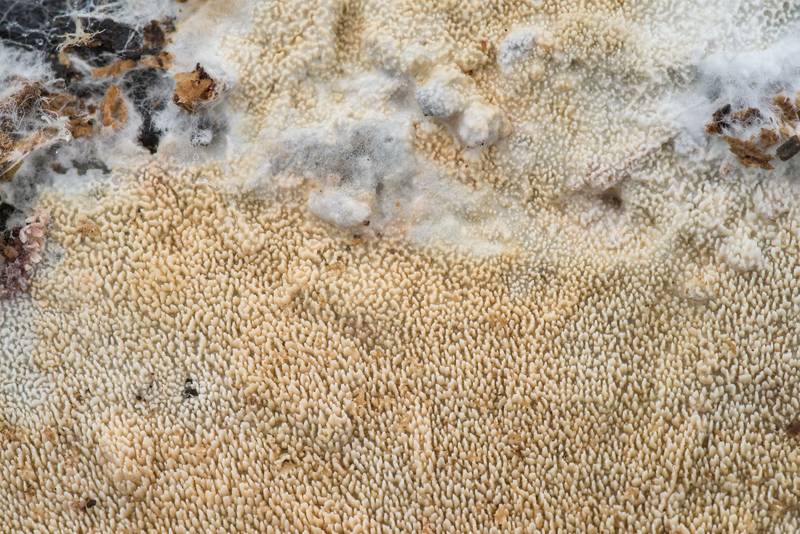
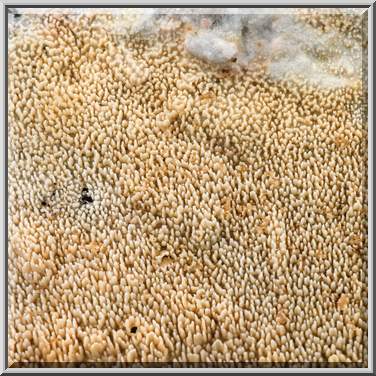
Texture of yellowish tooth-like corticioid fungus on soft rotten wood in Lick Creek ParkLick Creek: Background Notes. College Station, Texas


Album 3388: College Station, Texas, April 19, 2023
The image presents a detailed view of the surface of a soft, rotten piece of wood, likely from a tree that has decayed due to fungal infection. The dominant feature is an intricate network of fine, yellowish teeth or fibers, resembling coral or the texture of a sponge.
These tooth-like structures are densely packed and appear to be evenly distributed across the surface. It is challenging to discern any specific patterns or shapes within this arrangement. Some dark areas can be observed on the left side of the image, possibly representing remnants of the original wood or other debris that has accumulated on the surface over time.
The coloration of the fungus is primarily yellowish-white, but there are also some darker gray and brown spots visible in certain regions. These darker patches may indicate areas where the fungal growth is more robust or where other microorganisms have colonized the surface.
Overall, the image provides a fascinating glimpse into the intricate details of a decaying piece of wood and its subsequent colonization by various types of fungi. The texture and coloration of the fungus suggest that it plays an important role in breaking down organic matter in ecosystems, contributing to nutrient cycling and soil formation. – AI vision
🇪🇸 Descripción en español / Spanish Description
Textura de un hongo corticioide parecido a los dientes amarillentos en madera podrida blanda en Lick Creek Park. College Station, Texas, 19 de abril de 2023. La imagen presenta una vista detallada de la superficie de una pieza de madera blanda y podrida, probablemente de un árbol que se ha deteriorado debido a una infección fúngica. La característica dominante es una red intrincada de dientes o fibras finos amarillentos, similares a coral o la textura de una esponja. Estas estructuras parecidas a los dientes están densamente empaquetadas y parecen estar distribuidas uniformemente en toda la superficie. Es difícil discernir cualquier patrón o forma específica dentro de esta disposición. Algunas áreas oscuras pueden observarse en el lado izquierdo de la imagen, representando posiblemente restos de la madera original u otros residuos que se han acumulado en la superficie con el tiempo. La coloración del hongo es principalmente blanco amarillento, pero también se pueden observar algunas manchas más oscuras grises y marrones visibles en determinadas regiones. Estas manchas más oscuras pueden indicar áreas donde el crecimiento fúngico es más robusto o donde otros microorganismos han colonizado la superficie. En general, la imagen proporciona una mirada fascinante a los detalles intrincados de un trozo de madera en proceso de descomposición y su posterior colonización por diferentes tipos de hongos. La textura y coloración del hongo sugieren que juega un papel importante en la descomposición de la materia orgánica en los ecosistemas, contribuyendo al ciclo de nutrientes y a la formación de suelo. – Spanish translation


