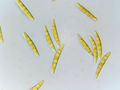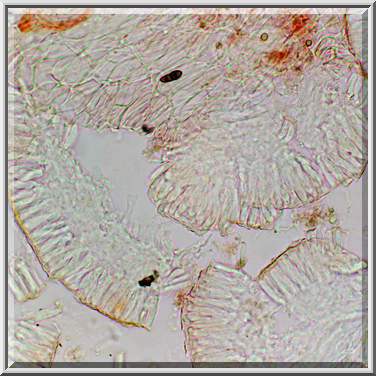
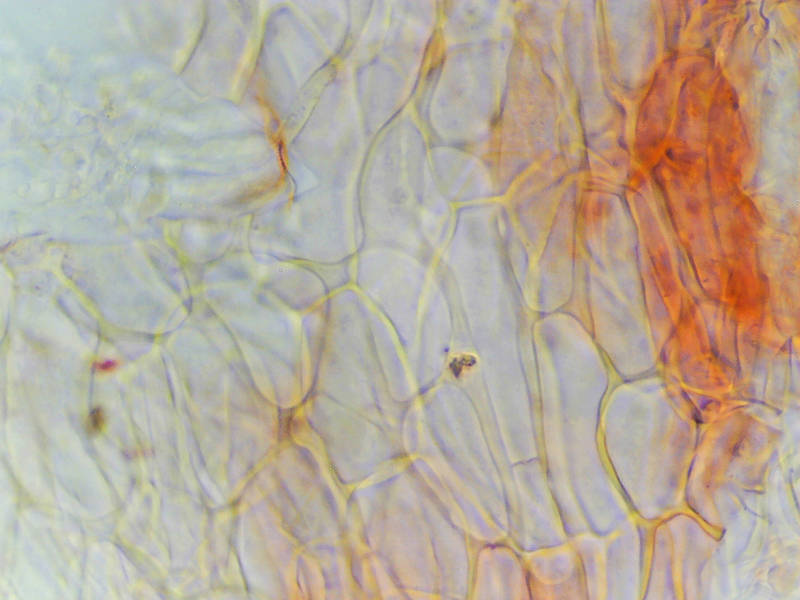
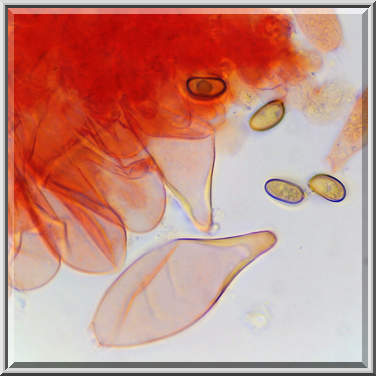
Tissues of Ascomycete fungus Hyalorbilia inflatula from pecan or may be oak, collected in Lick Creek ParkLick Creek: Background Notes. College Station, Texas


Album 3426: College Station, Texas, November 15 - 16, 2023
The image presents a microscopic view of fungal hyphae, likely obtained using light microscopy due to its detailed appearance and coloration. The image features numerous thin, filamentous structures (hyphae) that are predominantly yellowish-orange in hue, with some appearing blue or purple.
Upon closer inspection, it becomes apparent that the image is not a photograph but rather a digital reconstruction of a microscopic view. This conclusion is based on the following observations:
* The image lacks the characteristic graininess associated with photographs.
* The colors appear more vibrant and uniform than those found in photographs.
* The image's resolution suggests it was generated by a computer program designed to simulate microscopy.
The background of the image is predominantly white, which may indicate that the sample has been mounted on a glass slide. This mounting process often involves placing a small amount of water or other solution on the slide before adding the sample.
Based on the provided caption and the image itself, it can be inferred that the fungal hyphae are likely from an Ascomycete species, specifically Hyalorbilia inflatula. The mention of pecan or oak as possible sources for the sample suggests that the fungus may be associated with these plant species. However, without further information or context, it is difficult to determine the exact relationship between the fungus and its host.
Overall, the image provides a detailed view of fungal hyphae, highlighting their unique characteristics and structure. While some details remain unclear due to the lack of additional context, the image offers valuable insights into the microscopic world of fungi. – AI vision
🇪🇸 Descripción en español / Spanish Description
Los tejidos del hongo ascomiceto Hyalorbilia inflatula de pacana o roble, recolectados en Lick Creek Park. College Station, Texas, el 15 de noviembre de 2023. La imagen presenta una vista microscópica de las hifas fúngicas, probablemente obtenida utilizando microscopía óptica debido a su apariencia detallada y coloración. La imagen presenta numerosas estructuras filamentosas delgadas (hifas) que son predominantemente de tonalidad naranja amarillento, con algunas que aparecen azules o moradas. Tras un análisis más detallado, se hace evidente que la imagen no es una fotografía sino una reconstrucción digital de una vista microscópica. Esta conclusión se basa en las siguientes observaciones:
* La imagen carece del grano característico asociado con las fotografías. * Los colores aparecen más vibrantes y uniformes que los encontrados en fotografías. * La resolución de la imagen sugiere que fue generada por un programa informático diseñado para simular microscopía. El fondo de la imagen es predominantemente blanco, lo que puede indicar que la muestra se ha montado en un portaobjetos de vidrio. Este proceso de montaje a menudo involucra colocar una pequeña cantidad de agua u otra solución en el portaobjetos antes de añadir la muestra. En base al texto de presentación y la imagen, se puede inferir que las hifas fúngicas son probablemente de una especie Ascomycete, específicamente Hyalorbilia inflatula. La mención de pacana o roble como posibles fuentes para la muestra sugiere que el hongo podría estar asociado con estas especies vegetales. Sin embargo, sin más información o contexto, es difícil determinar la relación exacta entre el hongo y su huésped. En general, la imagen proporciona una vista detallada de las hifas fúngicas, resaltando sus características y estructura únicas. Aunque algunos detalles siguen sin estar claros debido a la falta de contexto adicional, la imagen ofrece valiosos conocimientos sobre el mundo microscópico de los hongos. – Spanish translation