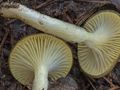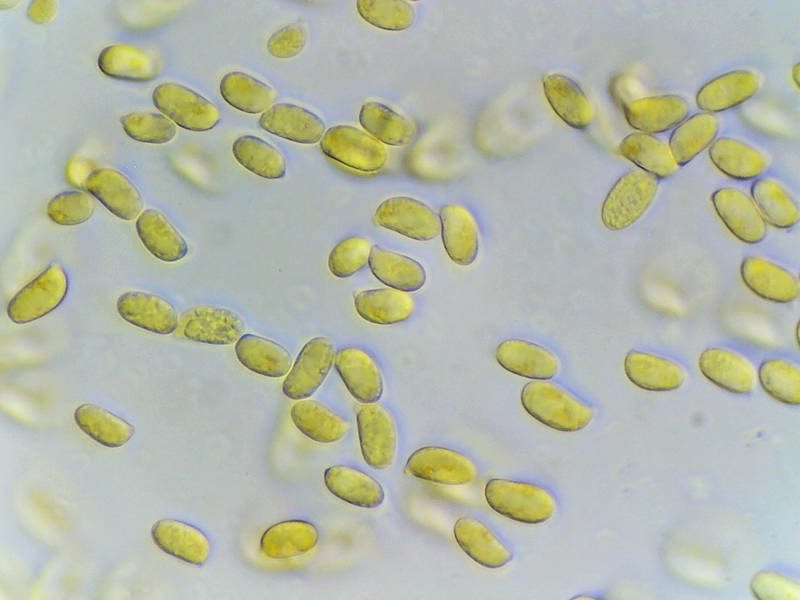

Spores (in lugol) of mushrooms Hygrophorus hypothejus(?) collected in Sam Houston National Forest near Montgomery. Texas


Album 3456: Sam Houston Forest, Texas, January 6, 2024
The image presents a microscopic view of spores from a mushroom species, specifically identified as **Hygrophorus hypothejus** by the collector. These spores were obtained through microscopy and are stained with Lugol's iodine solution.
**Spore Characteristics:**
* The spores exhibit an elliptical shape.
* They display yellowish coloration due to the staining process.
* The spores appear to be of uniform size, suggesting consistent development within the mushroom.
**Background:**
* The background is a plain white surface.
* This is likely a microscopic slide or cover slip used for observing biological specimens under a microscope.
**Observations and Inferences:**
* **Spore Size:** The spores in this image are relatively small, indicating that they have not yet reached maturity. Immature spores tend to be smaller than mature ones.
* **Staining Method:** The use of Lugol's iodine solution for staining the spores suggests an attempt to highlight specific features or structures within the cells. This method is commonly employed in microscopy labs to facilitate identification and analysis of biological specimens.
**Conclusion:**
The provided image offers a detailed view of the microscopic structure of **Hygrophorus hypothejus** spores, allowing for observation of their shape, size, and coloration under magnification. The use of Lugol's iodine staining technique enhances the visibility of cellular details, contributing to a better understanding of these biological entities. – AI vision
🇪🇸 Descripción en español / Spanish Description
Las esporas (en solución de Lugol) de hongos Hygrophorus hypothejus recolectados en el bosque nacional Sam Houston cerca de Montgomery, Texas, el 6 de enero de 2024. La imagen presenta una vista microscópica de las esporas de una especie de hongo, específicamente identificada como **Hygrophorus hypothejus** por el colector. Estas esporas se obtuvieron a través de microscopía y están teñidas con solución de yodo de Lugol.
**Características de las Espermas:** * Las esporas presentan una forma elíptica. * Muestran una coloración amarillenta debido al proceso de tinción. * Las esporas parecen ser de tamaño uniforme, lo que sugiere un desarrollo consistente dentro del hongo.
**Antecedentes:**
* El fondo es una superficie blanca lisa. * Es probablemente un portaobjetos o cubreobjetos microscópico usado para observar especímenes biológicos bajo un microscopio. **Observaciones e Inferencias:**
* **Tamaño de las esporas:** Las esporas en esta imagen son relativamente pequeñas, lo que indica que aún no han alcanzado la madurez. Las esporas inmaduras tienden a ser más pequeñas que las maduras.
* **Método de tinción:** El uso de solución de yodo de Lugol para teñir las esporas sugiere un intento de resaltar características o estructuras específicas dentro de las células. Este método se emplea comúnmente en laboratorios de microscopía para facilitar la identificación y análisis de muestras biológicas.
**Conclusión:** La imagen proporcionada ofrece una vista detallada de la estructura microscópica de las esporas **Hygrophorus hypothejus**, permitiendo la observación de su forma, tamaño y coloración bajo ampliación. El uso del método de tinción con yodo de Lugol mejora la visibilidad de los detalles celulares, lo que contribuye a una mejor comprensión de estas entidades biológicas. – Spanish translation