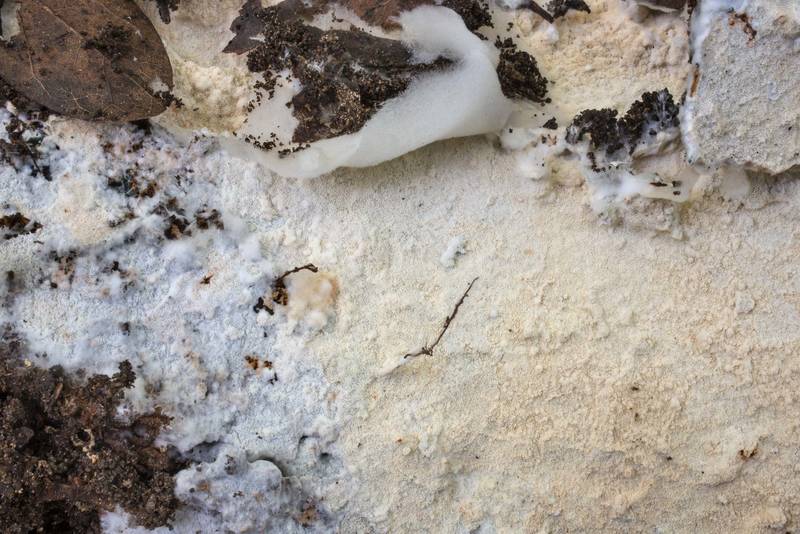

Close-up of dusty tan corticioid fungus on a log in Lick Creek ParkLick Creek: Background Notes. College Station, Texas


Album 3507: Sam Houston Forest, College Station, Texas, April 3 - 6, 2024
The image presents a close-up view of a dusty tan corticioid fungus growing on a log in Lick Creek Park, College Station, Texas. The image showcases various aspects of the fungal growth and its surroundings.
* **Fungus Growth**
* The fungus appears to be a type of corticioid fungus, characterized by its crust-like or shelf-like growth habit.
* It has a dusty tan coloration with some darker brown patches scattered throughout.
* The fungus is growing on the surface of the log, covering a significant portion of it.
* **Log Surface**
* The log surface beneath the fungus is rough and weathered, indicating that it may be an older piece of wood.
* There are some small cracks and crevices visible in the log's surface, which could provide additional habitat for other microorganisms or insects.
* **Environmental Context**
* The image was taken in Lick Creek Park, College Station, Texas, on April 4th, suggesting that it is a springtime specimen.
* The presence of the fungus on a log implies that it may be a decomposer or saprotroph, breaking down organic matter and recycling nutrients.
Overall, the image provides a detailed view of the dusty tan corticioid fungus growing on a log in Lick Creek Park. The fungus appears to be thriving on the rough, weathered surface of the log, and its presence suggests that it may play an important role in decomposing organic matter and recycling nutrients in the ecosystem. – AI vision
🇪🇸 Descripción en español / Spanish Description
Primer plano del hongo corticiano parduzco en un tronco en Lick Creek Park. College Station, Texas, 4 de abril de 2024. La imagen presenta una vista detallada de un hongo corticiano de color pardo oscuro que crece en un tronco en Lick Creek Park, College Station, Texas. La imagen muestra varios aspectos del crecimiento fúngico y sus alrededores. * **Crecimiento Fúngico** * El hongo parece ser un tipo de hongo corticiano, caracterizado por su hábitat de crecimiento similar a una corteza o estante. * Tiene una coloración parduzca con manchas más oscuras dispersas por toda ella. * El hongo está creciendo en la superficie del tronco, cubriendo una parte significativa de él. * **Superficie del Tronco** * La superficie del tronco debajo del hongo es áspera y erosionada, lo que indica que puede tratarse de un trozo de madera antiguo. * Hay algunas grietas y hendiduras visibles en la superficie del tronco, lo que podría proporcionar un hábitat adicional para otros microorganismos o insectos. * **Contexto Ambiental** * La imagen fue tomada en Lick Creek Park, College Station, Texas, el 4 de abril, lo que sugiere que se trata de una muestra de la época de primavera. * La presencia del hongo en un tronco implica que puede tratarse de un descompostador o saprotrofo, descomponiendo materia orgánica y reciclando nutrientes. En general, la imagen proporciona una vista detallada del hongo corticiano parduzco que crece en un tronco en Lick Creek Park. El hongo parece estar prosperando en la superficie áspera y erosionada del tronco, y su presencia sugiere que podría desempeñar un papel importante en la descomposición de materia orgánica y el reciclaje de nutrientes en el ecosistema. – Spanish translation