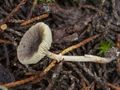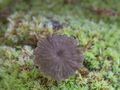

Tiny mushrooms Lepiota roseolivida(?) on Closed Trail in Lick Creek ParkLick Creek: Background Notes. College Station, Texas


Album 3530: College Station, Texas, May 8, 2024
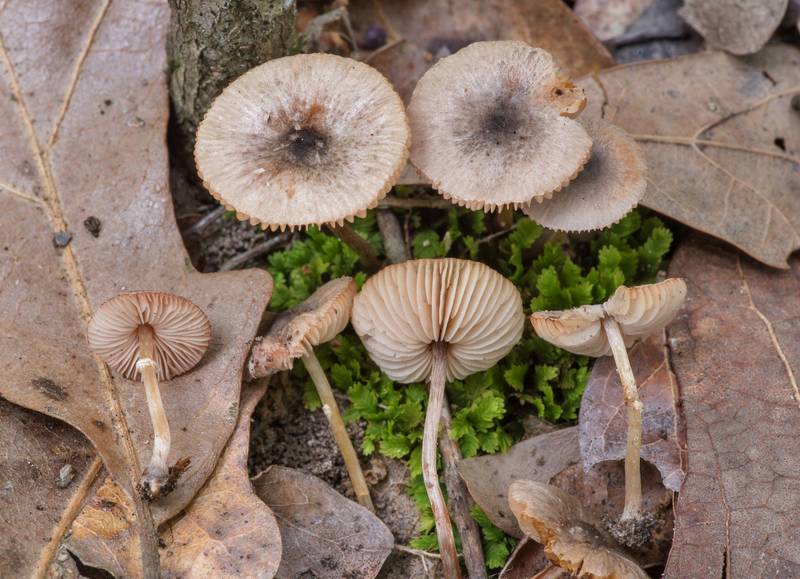
The image presents a close-up view of several tiny mushrooms growing amidst leaves and twigs on the forest floor.
The five small caps are tan with light brown edges around them. The gills are light-colored with darker centers.
They appear to be growing in a ring formation, which suggests that they are part of the Lepiota genus.
Lepiota roseolivida is a rare and endangered species found only in certain parts of Texas, including College Station where this photograph was taken. The mushrooms' growth cycle spans from early spring into late summer or fall. They typically grow on the forest floor, often near deciduous trees, and thrive in damp environments. Their white gills with dark centers are distinctive features that set them apart from other species. The caps of Lepiota roseolivida are small to medium-sized (1-3 cm) and have a characteristic pinkish-brown color when young, gradually turning darker brown as they mature. The stems are thin and wiry, ranging in length from 2-6 cm.
The mushrooms are likely growing on the forest floor due to their preference for well-drained soil and partial shade. They thrive in environments with low levels of disturbance, making them sensitive to human activities such as logging or development. As a result, conservation efforts are essential to protect these rare species and preserve their habitats.
In summary, the image showcases five tiny mushrooms belonging to the Lepiota roseolivida species growing on the forest floor in College Station, Texas. Their distinctive features include light-colored gills with dark centers, small to medium-sized caps, and wiry stems. These rare and endangered mushrooms require specific environmental conditions to thrive and are sensitive to human activities. Therefore, it is crucial to protect their habitats through conservation efforts to ensure the long-term survival of this unique species. – AI vision
🇪🇸 Descripción en español / Spanish Description
Hongos pequeños Lepiota roseolivida en el Sendero Cerrado del Parque Lick Creek. College Station, Texas, 8 de mayo del 2024. La imagen presenta una vista cercana de varios hongos pequeños que crecen entre las hojas y ramitas en el suelo del bosque. Las cinco pequeñas setas son de color canela con bordes marrones claros alrededor de ellas. Las láminas son de color claro con centros más oscuros. Parecen estar creciendo en una formación circular, lo que sugiere que pertenecen al género Lepiota. Lepiota roseolivida es una especie rara y amenazada que solo se encuentra en ciertas partes de Texas, incluida College Station donde se tomó esta fotografía. El ciclo de crecimiento de los hongos dura desde principios de primavera hasta finales del verano u otoño. Crece generalmente en el suelo del bosque, a menudo cerca de árboles de hoja caduca y prospera en entornos húmedos. Sus láminas blancas con centros oscuros son características distintivas que los diferencian de otras especies. Los sombreros de Lepiota roseolivida son de tamaño pequeño a mediano (1-3 cm) y presentan un color rosado-marrón característico cuando son jóvenes, volviéndose pardo oscuro a medida que maduran. Los tallos son delgados y finos, midiendo de 2 a 6 cm de largo. Es probable que los hongos crezcan en el suelo debido a su preferencia por suelo bien drenado y sombra parcial. Prosperan en entornos con bajo nivel de perturbación, lo que los hace sensibles a actividades humanas como la tala o el desarrollo. Por consiguiente, los esfuerzos de conservación son fundamentales para proteger estas especies raras y preservar sus hábitats. En resumen, la imagen muestra cinco hongos pequeños que pertenecen a la especie Lepiota roseolivida creciendo en el suelo del bosque en College Station, Texas. Sus rasgos distintivos incluyen láminas de color claro con centros oscuros, sombreros de tamaño pequeño a mediano y tallos finos. Estos hongos raros y amenazados requieren condiciones ambientales específicas para prosperar y son sensibles a actividades humanas. Por lo tanto, es fundamental proteger sus hábitats mediante esfuerzos de conservación para garantizar la supervivencia a largo plazo de esta especie única. – Spanish translation