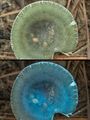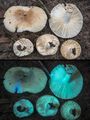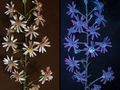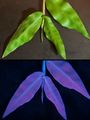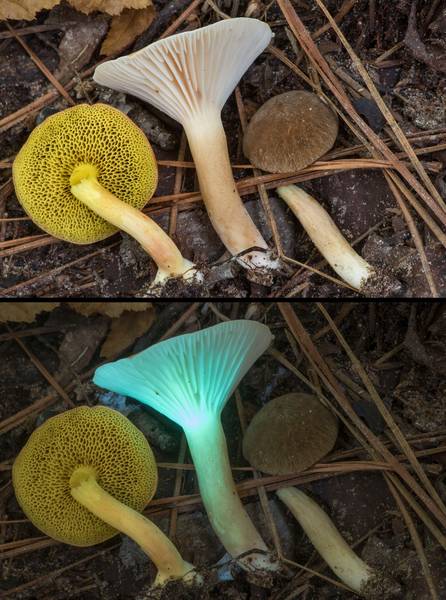

Bolete and milkcap (Lactarius) mushrooms when exposed to regular daylight as well as when illuminated by a 365 nm ultraviolet (UV-A) blacklight on Caney Creek section of Lone Star Hiking Trail in Sam Houston National Forest north from Montgomery. Texas


Album 3605: College Station, Texas, August 17 - 21, 2024
The image shows two photographs of mushrooms, taken under different lighting conditions. The top photograph is taken with regular daylight, while the bottom photograph is illuminated by a blacklight emitting ultraviolet (UV-A) light at a wavelength of 365 nm.
**Top Photograph:**
* In this photograph, the mushrooms are not fluorescing.
* They appear as they would in normal daylight, without any visible signs of fluorescence.
* The background of the photograph is dark, which helps to highlight the details of the mushrooms.
* The overall effect is one of a typical forest floor scene, with the mushrooms blending in with their surroundings.
**Bottom Photograph:**
* In this photograph, the mushrooms are fluorescing brightly.
* They emit a vibrant blue-green glow when exposed to UV-A light, making them stand out against the dark background.
* The fluorescence is most pronounced on the caps of the mushrooms, which appear as bright blue-green spots in the image.
* The stems and gills of the mushrooms also fluoresce, although less intensely than the caps.
**Comparison:**
* By comparing the two photographs, it becomes clear that the UV-A light has a significant effect on the appearance of the mushrooms.
* In the top photograph, the mushrooms appear dull and unremarkable in regular daylight, while in the bottom photograph they are transformed into vibrant, glowing objects when exposed to UV-A light.
**Conclusion:**
* The image highlights the importance of using appropriate lighting conditions when observing fungi.
* Regular daylight may not be sufficient to reveal the full range of colors and patterns present on mushroom caps.
* By using a blacklight emitting UV-A light, it is possible to bring out the unique characteristics of these organisms and gain a better understanding of their biology and ecology. – AI vision
🇪🇸 Descripción en español / Spanish Description
El boletus y el leucocóctico (Lactarius) se ven afectados por la luz del día regular, así como cuando son iluminados con una luz negra ultravioleta (UV-A) de 365 nm en la sección Caney Creek del Lone Star Hiking Trail en el Bosque Nacional Sam Houston al norte de Montgomery. Texas, 18 de agosto de 2024. La imagen muestra dos fotografías de hongos tomadas bajo diferentes condiciones de iluminación. La parte superior de la fotografía es tomada con luz del día normal, mientras que la parte inferior está iluminada con una luz negra que emite luz ultravioleta (UV-A) a una longitud de onda de 365 nm.
**Parte superior de la fotografía:** *En esta fotografía, los hongos no fluorescen.* *Aparecen como lo harían en la luz diurna normal, sin ningún signo visible de fluorescencia.* *El fondo de la fotografía es oscuro, lo que ayuda a destacar los detalles de los hongos.* *El efecto general es el de una típica escena del suelo forestal, con los hongos mezclándose con sus alrededores.* **Parte inferior de la fotografía:** *En esta fotografía, los hongos están brillantemente fluorescentes.* *Emiten un intenso brillo verde azulado cuando se exponen a la luz UV-A, lo que hace que destaquen contra el fondo oscuro.* *La fluorescencia es más pronunciada en las tapas de los hongos, que aparecen como manchas brillantes azul verdosas en la imagen.* *Los tallos y las láminas de los hongos también se iluminan, aunque menos intensamente que las tapas.* **Comparación:** *Al comparar las dos fotografías, queda claro que la luz UV-A tiene un efecto significativo en el aspecto de los hongos.* *En la parte superior de la fotografía, los hongos aparecen oscuros e insignificantes a la luz del día normal, mientras que en la parte inferior de la fotografía se transforman en objetos vibrantes y brillantes cuando se exponen a la luz UV-A.* **Conclusión:** *La imagen pone de manifiesto la importancia de utilizar las condiciones de iluminación apropiadas al observar los hongos.* *La luz del día normal puede no ser suficiente para revelar toda la gama de colores y patrones presentes en las tapas de los hongos.* *Al utilizar una luz negra que emite luz ultravioleta (UV-A), es posible destacar las características únicas de estos organismos y obtener un mejor entendimiento de su biología y ecología. – Spanish translation