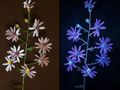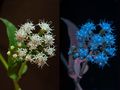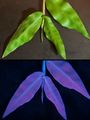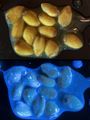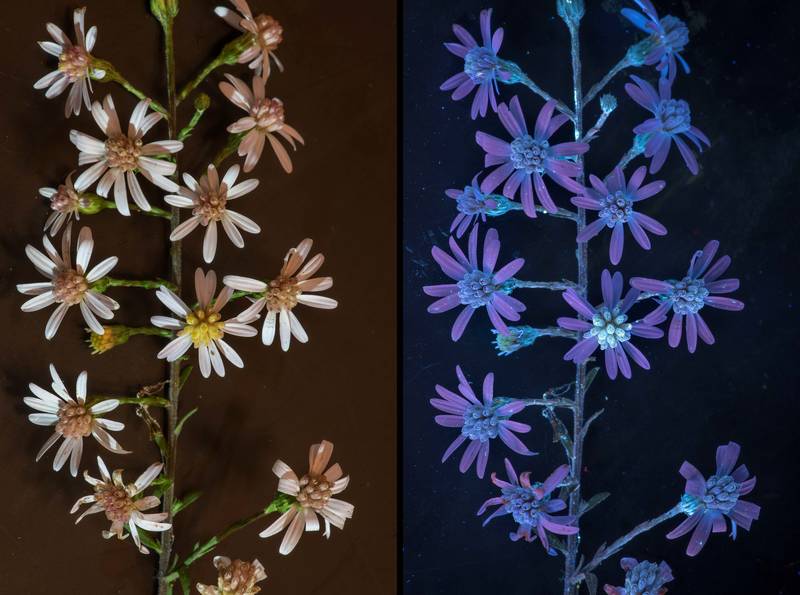

White aster Symphyotrichum drummondii when exposed to regular daylight as well as when illuminated by a 365 nm ultraviolet (UV-A) blacklight from Caney Creek section of Lone Star Hiking Trail in Sam Houston National Forest north from Montgomery. Texas


Album 3630: College Station - Sam Houston Forest, Texas, October 9 - 10, 2024
The image presents a comparative analysis of white aster flowers under two distinct lighting conditions: regular daylight and ultraviolet (UV-A) blacklight illumination. The photograph is divided into two sections, with the left side depicting the flowers in their natural state under daylight and the right side showcasing them when illuminated by UV-A light.
**Daylight Image:**
* The white aster flowers are displayed against a dark background.
* The stems of the plants appear to be slightly bent or curved, suggesting that they may have been photographed at an angle.
* The flowers themselves are small and delicate, with white petals that are not fully open. They resemble daisies but lack their bright yellow centers.
**UV-A Blacklight Image:**
* In contrast to the daylight image, the UV-A blacklight image reveals a striking transformation of the flowers.
* Under this specialized light source, the white petals glow in a vibrant purple hue, while the stems and leaves appear more translucent.
* The overall effect is as if the flowers have been infused with an otherworldly radiance.
**Comparison:**
* A notable difference between the two images is the way the UV-A blacklight highlights the delicate details of the flower's structure.
* In the daylight image, it is difficult to discern the intricate patterns and textures of the petals. However, under the UV-A light, these features become starkly visible.
**Conclusion:**
The image effectively demonstrates how different lighting conditions can significantly alter our perception of natural objects. The use of UV-A blacklight in this context reveals new aspects of the flowers' appearance, highlighting their unique characteristics and textures that might otherwise go unnoticed. This visual comparison underscores the importance of considering various lighting conditions when observing and interpreting biological phenomena. – AI vision
🇪🇸 Descripción en español / Spanish Description
La flor blanca de aster Symphyotrichum drummondii cuando se expone a la luz diurna regular, así como también cuando se ilumina con una luz negra ultravioleta (UV-A) de 365 nm en la sección Caney Creek del Sendero Hiking Lone Star en el Bosque Nacional Sam Houston al norte de Montgomery. Texas, el 10 de octubre de 2024. La imagen presenta un análisis comparativo de las flores de aster blanco bajo dos condiciones de iluminación distintas: luz diurna regular e iluminación con luz negra ultravioleta (UV-A). La fotografía se divide en dos secciones, con el lado izquierdo mostrando las flores en su estado natural bajo la luz del día y el lado derecho presentándolas cuando están iluminadas por la luz UV-A.
**Imagen de luz diurna:** * Las flores de aster blancas se muestran contra un fondo oscuro. * Los tallos de las plantas parecen estar ligeramente doblados o curvados, lo que sugiere que pueden haberse fotografiado en ángulo. * Las flores mismas son pequeñas y delicadas, con pétalos blancos que no están completamente abiertos. Se asemejan a margaritas, pero carecen de centros amarillos brillantes.
**Imagen de luz UV-A:** * A diferencia de la imagen de luz diurna, la imagen de luz negra ultravioleta (UV-A) revela una transformación sorprendente de las flores. * Bajo esta fuente de luz especializada, los pétalos blancos brillan en un tono púrpura vibrante, mientras que los tallos y hojas aparecen más translúcidos. * El efecto general es como si se hubiese infundido a las flores una radiación sobrenatural.
**Comparación:** * Una diferencia notable entre las dos imágenes es la forma en que la luz UV-A resalta los delicados detalles de la estructura de la flor. * En la imagen de luz diurna, es difícil distinguir los intrincados patrones y texturas de los pétalos. Sin embargo, bajo la luz UV-A, estas características se vuelven muy visibles.
**Conclusión:** La imagen demuestra efectivamente cómo diferentes condiciones de iluminación pueden alterar significativamente nuestra percepción de objetos naturales. El uso de la luz negra ultravioleta en este contexto revela nuevos aspectos del aspecto de las flores, resaltando sus características y texturas únicas que podrían pasar desapercibidas. Esta comparación visual subraya la importancia de considerar diferentes condiciones de iluminación al observar e interpretar fenómenos biológicos. – Spanish translation