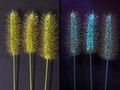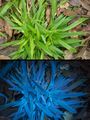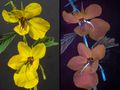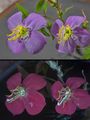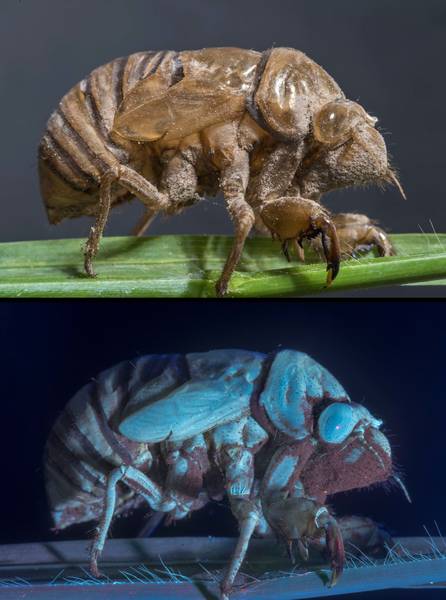

Exoskeleton of a molted cicada on a grass blade when exposed to regular daylight as well as when illuminated by a 365 nm ultraviolet (UV-A) blacklight in Lick Creek ParkLick Creek: Background Notes. College Station, Texas


Album 3606: College Station, Texas, August 22 - 23, 2024
The image presents a striking comparison between the appearance of a cicada exoskeleton under regular daylight and when illuminated by ultraviolet (UV-A) light.
**Regular Daylight:**
* The top half of the image features an exoskeleton of a molted cicada placed on a grass blade.
* Under normal lighting conditions, the exoskeleton exhibits a brownish hue with visible cracks and crevices.
* The overall appearance suggests that the cicada has recently shed its skin as it undergoes metamorphosis.
**Ultraviolet (UV-A) Light:**
* Below the regular daylight image is another photograph of the same exoskeleton, but this time illuminated by a 365 nm UV-A blacklight.
* Under UV-A light, the exoskeleton displays a vibrant blue coloration, accentuating its intricate details and patterns.
* The cracks and crevices in the exoskeleton are also more pronounced when viewed under UV-A illumination.
**Key Observations:**
* The contrast between the two images highlights the importance of considering lighting conditions when observing natural phenomena.
* The use of UV-A light reveals hidden features and colors that would otherwise remain invisible to the naked eye.
* This technique can be useful in various fields, such as entomology, botany, and forensic science, where subtle details can hold significant significance.
In summary, the image showcases the transformative power of lighting on our perception of the natural world. By switching from regular daylight to UV-A light, we gain a new appreciation for the intricate textures and colors present in even the most mundane objects. – AI vision
🇪🇸 Descripción en español / Spanish Description
El exoesqueleto de una cicada desmoldeada en una hoja de hierba cuando se expone a la luz diurna regular, así como cuando se ilumina con una luz negra ultravioleta (UV-A) de 365 nm en el Lick Creek Park. College Station, Texas, 23 de agosto de 2024. La imagen presenta una sorprendente comparación entre la apariencia del exoesqueleto de una cicada bajo luz diurna regular y cuando se ilumina con luz ultravioleta (UV-A).
**Luz Diurna Regular:** *La mitad superior de la imagen presenta un exoesqueleto de una cicada desmoldeada colocado en una hoja de hierba. *Bajo condiciones normales de iluminación, el exoesqueleto muestra un tono parduzco con grietas y hendiduras visibles. *El aspecto general sugiere que la cicada ha derramado recientemente su piel mientras experimenta la metamorfosis.
**Luz Ultravioleta (UV-A):* *A continuación de la imagen de luz diurna regular se encuentra otra fotografía del mismo exoesqueleto, pero esta vez iluminada por una luz negra UV-A de 365 nm. *Bajo luz ultravioleta (UV-A), el exoesqueleto muestra un color azul vibrante, lo que acentúa sus detalles e intrincados patrones. *Las grietas y hendiduras en el exoesqueleto también son más prominentes cuando se ven bajo iluminación UV-A.
**Observaciones Clave:** *La contrastada entre las dos imágenes destaca la importancia de considerar las condiciones de iluminación al observar fenómenos naturales. *El uso de luz ultravioleta (UV-A) revela rasgos ocultos y colores que, de lo contrario, permanecerían invisibles a simple vista. *Esta técnica puede ser útil en diversos campos, como entomología, botánica y ciencia forense, donde detalles sutiles pueden tener un significado importante.
En resumen, la imagen destaca el poder transformador de la iluminación en nuestra percepción del mundo natural. Al cambiar de luz diurna regular a UV-A, obtenemos una nueva apreciación por las texturas e intrincados colores presentes incluso en los objetos más cotidianos. – Spanish translation