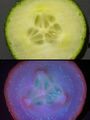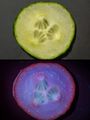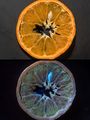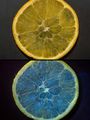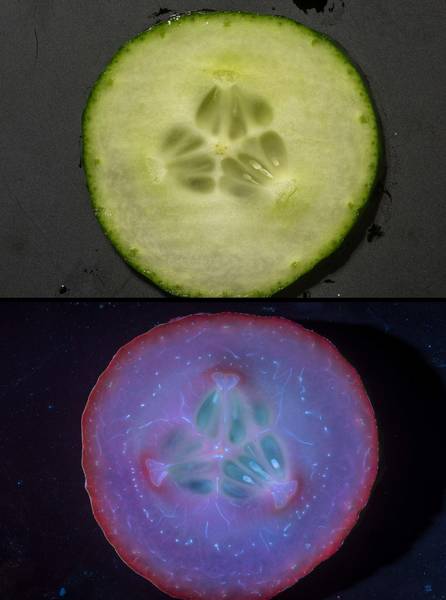

Slice of English cucumber from a supermarket when exposed to regular daylight as well as when illuminated by a 365 nm ultraviolet (UV-A) blacklight. College Station, Texas


Album 3608: College Station, Texas, August 25 - 26, 2024
The image presents a comparative analysis of an English cucumber slice under two distinct lighting conditions: regular daylight and ultraviolet (UV-A) light from a 365 nm blacklight. The top half of the image features a cucumber slice illuminated by normal daylight, while the bottom half showcases the same slice exposed to UV-A radiation.
**Daylight Illumination:**
* The cucumber slice appears greenish-yellow in color.
* Its surface exhibits a smooth texture with visible ridges along its circumference.
* The interior of the cucumber displays a pale yellow hue and features three small cavities or "seeds" arranged in a triangular pattern.
**Ultraviolet (UV-A) Illumination:**
* Under UV-A light, the cucumber slice transforms into a vibrant blue-purple color.
* Its surface remains relatively unchanged, with the ridges along its circumference still visible.
* The interior of the cucumber undergoes significant changes, taking on an intense purple hue and becoming more translucent.
* The three cavities or "seeds" become more pronounced, appearing as bright blue-green spots against the dark purple background.
**Comparison:**
* The most striking difference between the two images is the dramatic color shift caused by UV-A illumination, which highlights the natural pigments present in the cucumber.
* While the surface texture of the cucumber remains consistent across both lighting conditions, the interior undergoes a significant transformation under UV-A light, revealing its internal structure and pigment distribution.
In summary, the image effectively demonstrates how different lighting conditions can alter our perception of an object's appearance. By comparing the cucumber slice under regular daylight and UV-A illumination, we gain insight into the complex interactions between light, pigments, and texture that shape our visual experience of the natural world. – AI vision
🇪🇸 Descripción en español / Spanish Description
Un trozo de pepino inglés de un supermercado cuando se expone a la luz diurna normal y también cuando se ilumina con una luz negra ultravioleta (UV-A) de 365 nm. College Station, Texas, 25 de agosto de 2024. La imagen presenta un análisis comparativo de un trozo de pepino inglés bajo dos condiciones de iluminación distintas: luz diurna normal y luz ultravioleta (UV-A) de una linterna negra de 365 nm. La mitad superior de la imagen presenta un trozo de pepino iluminado con luz natural, mientras que la mitad inferior muestra el mismo trozo expuesto a radiación UV-A. **Iluminación diurna:** * El trozo de pepino inglés aparece de color amarillo verdoso. * Su superficie presenta una textura suave con crestas visibles a lo largo de su circunferencia. * El interior del pepino adopta un tono amarillo pálido y muestra tres pequeñas cavidades o "semillas" dispuestas en un patrón triangular. **Iluminación ultravioleta (UV-A):** * Bajo la luz UV-A, el trozo de pepino inglés adquiere un color azul-púrpura vibrante. * Su superficie se mantiene relativamente inalterada, con las crestas a lo largo de su circunferencia todavía visibles. * El interior del pepino experimenta cambios significativos, adquiriendo un tono púrpura intenso y volviéndose más translúcido. * Las tres cavidades o "semillas" aparecen más pronunciadas, lo que las convierte en manchas verde azuladas brillantes contra el fondo púrpura oscuro. **Comparación:** * La diferencia más notable entre las dos imágenes es el cambio drástico de color causado por la iluminación UV-A, que destaca los pigmentos naturales presentes en el pepino. * Mientras que la textura superficial del pepino se mantiene consistente bajo ambas condiciones de iluminación, el interior experimenta un cambio significativo bajo luz UV-A, revelando su estructura interna y la distribución de los pigmentos. En resumen, la imagen demuestra efectivamente cómo diferentes condiciones de iluminación pueden alterar nuestra percepción del aspecto de un objeto. Al comparar el trozo de pepino bajo luz diurna normal e iluminación UV-A, obtenemos información sobre las interacciones complejas entre la luz, los pigmentos y la textura que dan forma a nuestra experiencia visual del mundo natural. – Spanish translation