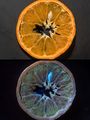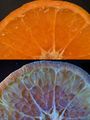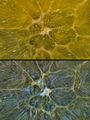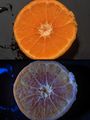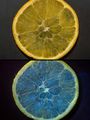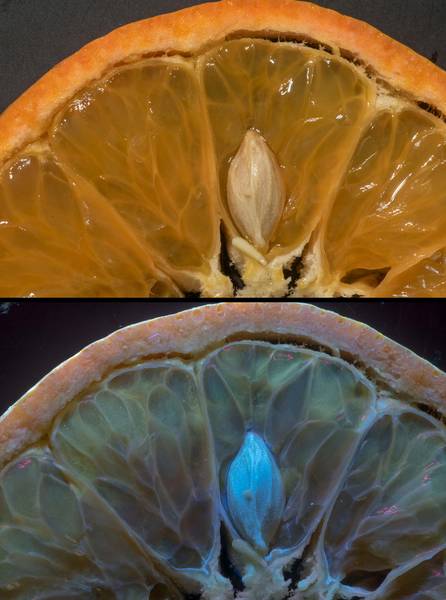

Close-up of a slice of an tangerine from Kroger supermarket when exposed to regular daylight as well as when illuminated by a 365 nm ultraviolet (UV-A) blacklight. College Station, Texas


Album 3609: College Station, Texas, August 27, 2024
The image features two close-up photographs of an orange slice from Kroger supermarket. The top image is taken under regular daylight conditions, while the bottom one is illuminated by a 365 nm ultraviolet (UV-A) blacklight.
In the top photograph, the orange slice appears as expected, with a smooth and slightly shiny texture. The peel exhibits a vibrant orange hue, gradually darkening towards the edges. Upon closer inspection, a small white seed is visible at the center of the slice. This seed has a rounded teardrop shape and a glossy surface.
In contrast, when exposed to UV-A blacklight, as shown in the bottom photograph, the orange slice undergoes significant changes. The peel now appears dull and lacks its natural coloration. Notably, the white seed at the center of the slice becomes illuminated by the UV light, revealing a striking blue-green hue. This transformation suggests that the seed contains fluorescent pigments or compounds that respond to ultraviolet radiation.
Overall, this image highlights the effects of ultraviolet light on various substances and materials, including food items like oranges. It demonstrates how UV-A blacklight can cause certain components to emit fluorescence, resulting in a change in appearance or coloration. – AI vision
🇪🇸 Descripción en español / Spanish Description
Primer plano de una rebanada de una tangerina del supermercado Kroger al exponerla a la luz natural habitual y también cuando se ilumina con luz negra ultravioleta (UV-A) de 365 nm. College Station, Texas, el 27 de agosto de 2024. La imagen presenta dos fotografías en primer plano de una rebanada de naranja del supermercado Kroger. La imagen superior se toma bajo condiciones de luz natural habituales, mientras que la inferior está iluminada con luz negra ultravioleta (UV-A) de 365 nm. En la fotografía superior, la rebanada de naranja aparece como se esperaba, con una textura suave y ligeramente brillante. La cáscara presenta un tono naranja vibrante, que se oscurece gradualmente hacia los bordes. Tras un examen más detallado, se puede ver un pequeño hueso blanco en el centro de la rebanada. Este hueso tiene una forma redondeada en forma de lágrima y una superficie brillante. Por el contrario, cuando se expone a la luz negra UV-A, como se muestra en la fotografía inferior, la rebanada de naranja experimenta cambios significativos. Ahora, la cáscara parece mate y carece de su coloración natural. Cabe destacar que el hueso blanco en el centro de la rebanada se ilumina con la luz UV, lo que revela un llamativo matiz azul-verdoso. Esta transformación sugiere que el hueso contiene pigmentos o compuestos fluorescentes que responden a la radiación ultravioleta. En general, esta imagen destaca los efectos de la luz ultravioleta en diversas sustancias y materiales, incluidos los alimentos como las naranjas. Demuestra cómo el UV-A negro puede hacer que ciertos componentes emitan fluorescencia, lo que resulta en un cambio de aspecto o coloración. – Spanish translation