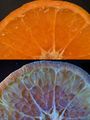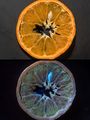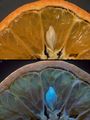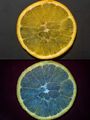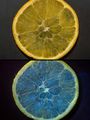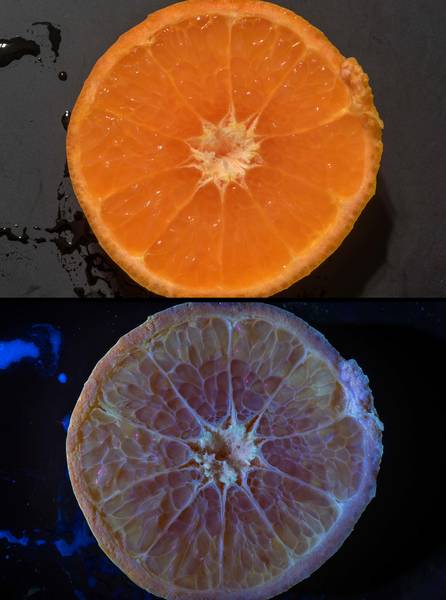

Section of a tangerine from Kroger supermarket when exposed to regular daylight as well as when illuminated by a 365 nm ultraviolet (UV-A) blacklight. College Station, Texas


Album 3609: College Station, Texas, August 27, 2024
The image presents a comparative analysis of the same tangerine section under two distinct lighting conditions: regular daylight and illumination by a 365 nm ultraviolet (UV-A) blacklight. The top half of the image showcases the tangerine's appearance when exposed to regular daylight, while the bottom half reveals its fluorescence when illuminated by the UV-A blacklight.
**Key Observations**
* **Daylight Exposure**: In the top half, the tangerine section appears vibrant and orange in color, with no visible signs of fluorescence or unusual luminescence.
* **UV-A Blacklight Illumination**: The bottom half of the image demonstrates a dramatic change. When exposed to the UV-A blacklight, the tangerine exhibits pronounced fluorescence, emitting a bright blue-green glow. This phenomenon is likely attributed to the presence of fluorescent compounds within the fruit, which absorb light at specific wavelengths and emit it back at longer wavelengths.
**Conclusion**
The image effectively illustrates the contrasting effects of different lighting conditions on the appearance of a tangerine section. The use of UV-A blacklight not only highlights the fruit's natural fluorescence but also underscores the importance of considering various environmental factors when evaluating the properties and characteristics of food items. – AI vision
🇪🇸 Descripción en español / Spanish Description
La sección de una mandarina del supermercado Kroger, expuesta a la luz del día regular y también cuando es iluminada por una luz negra ultravioleta (UV-A) de 365 nm. College Station, Texas, 27 de agosto de 2024. La imagen presenta un análisis comparativo de la misma sección de mandarina bajo dos condiciones de iluminación distintas: luz del día regular e iluminación por una luz negra ultravioleta (UV-A) de 365 nm. La mitad superior de la imagen muestra el aspecto de la mandarina cuando se expone a la luz del día, mientras que la mitad inferior revela su fluorescencia cuando es iluminada por la luz negra UV-A.
**Observaciones clave**:
* **Exposición a la Luz del Día**: En la mitad superior, la sección de mandarina parece vibrante y de color naranja, sin signos visibles de fluorescencia o luminiscencia inusual.
* **Iluminación con Luz Negra UV-A**: La mitad inferior de la imagen muestra un cambio drástico. Cuando se expone a la luz negra UV-A, la mandarina exhibe una fluorescencia pronunciada, emitiendo un brillo azul-verde brillante. Este fenómeno se atribuye probablemente a la presencia de compuestos fluorescentes dentro de la fruta, que absorben luz en longitudes de onda específicas y la emiten de vuelta a longitudes de onda más largas.
**Conclusión**: La imagen ilustra efectivamente los contrastantes efectos de diferentes condiciones de iluminación sobre el aspecto de una sección de mandarina. El uso de luz negra UV-A no solo destaca la fluorescencia natural de la fruta, sino que también subraya la importancia de considerar varios factores ambientales al evaluar las propiedades y características de los artículos alimenticios. – Spanish translation