 |
| |||||||||||||||

| ||||||||||||||||


| Similar |   |
  |
  |
  |
  |
| |||||||||||||||||||||||||||
| |||||||||||||||||||||||||||
| 1996 1997 1998 1999 2000 2001 2002 2003 2004 2005 2006 2007 2008 2009 2010 2011 2012 2013 2014 2015 2016 2017 2018 2019 2020 2021 2022 2023 2024 2025 2026 | |||||||||||||||||||||||||||
| New version Slide Show Most Popular Full List Statistics Technical Details Home Page | |||||||||||||||||||||||||||
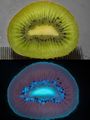
The image presents a comparative analysis of a kiwi fruit slice under two distinct lighting conditions: regular daylight and illumination by a 365 nm ultraviolet (UV-A) blacklight. The top portion of the image displays the kiwi slice exposed to natural daylight, showcasing its vibrant green color with visible brown seeds. In contrast, the bottom half of the image reveals the same kiwi slice when illuminated by the UV-A blacklight. This exposure causes a profound transformation, resulting in the fruit's surface appearing red and blue, accompanied by an increase in visibility of the seeds. The UV-A light effectively highlights the intricate details of the kiwi's anatomy. The striking difference between the two images demonstrates the unique properties of UV-A illumination, which can accentuate certain characteristics within organic materials. This phenomenon is likely due to the interaction between the UV radiation and the pigments present in the kiwi fruit, leading to a dramatic shift in coloration and visibility of internal structures. Overall, the image highlights the potential applications of UV-A lighting in revealing hidden details or enhancing the appearance of various substances, including food products like the kiwi fruit. – AI vision |
Un trozo de kiwi verde fresco expuesto a la luz del día regular y bajo iluminación ultravioleta (UV-A) de 365 nm. College Station, Texas, el 26 de agosto de 2024. La imagen presenta un análisis comparativo de una rodaja de kiwi en dos condiciones de iluminación distintas: luz del día regular e iluminación ultravioleta (UV-A) de 365 nm. La parte superior de la imagen muestra la rodaja de kiwi expuesta a la luz natural, mostrando su vibrante color verde con semillas marrones visibles. Por el contrario, la mitad inferior de la imagen muestra la misma rodaja de kiwi cuando se ilumina con luz UV-A. Esta exposición causa una profunda transformación, resultando en la apariencia roja y azul de la superficie del fruto, acompañada por un aumento en la visibilidad de las semillas. La luz UV-A destaca efectivamente los detalles intrincados de la anatomía del kiwi. La notable diferencia entre las dos imágenes demuestra las propiedades únicas de la iluminación UV-A, que pueden destacar ciertas características dentro de materiales orgánicos. Este fenómeno es probable que se deba a la interacción entre la radiación UV y los pigmentos presentes en el kiwi, lo que lleva a un cambio drástico en la coloración y la visibilidad de las estructuras internas. En general, la imagen destaca las potenciales aplicaciones de la iluminación UV-A en revelar detalles ocultos o mejorar la apariencia de varias sustancias, incluidos los productos alimenticios como el kiwi. – Spanish translation |
Keyword variants
high resolution online digital collection
Berlin on the Brazos
Lone Star State
United States
picture gallery
photo album
documentary photographs
daily pics
conservative town
Brazos County
TX
travelogue
snapshots
sightseeing
photowalks
photoblog
graphic
fotografias
foto
Bryan
America
Aggieland