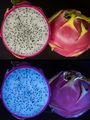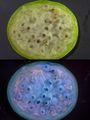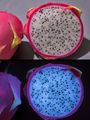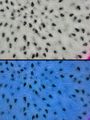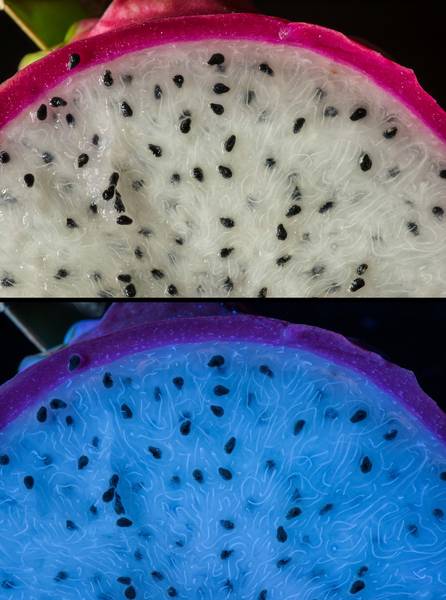

Slice of a dragon fruit when exposed to regular daylight as well as when illuminated by a 365 nm ultraviolet (UV-A) blacklight from HEB supermarket. College Station, Texas


Album 3631: College Station and Sam Houston Forest, Texas, October 11 - 13, 2024
The image presents two photographs of a dragon fruit slice, one taken under regular daylight and the other illuminated by a UV-A blacklight. The top photograph shows the dragon fruit slice in its natural coloration, with a pink skin and white flesh speckled with small black seeds. In contrast, the bottom photograph reveals that when exposed to the UV-A blacklight, the same slice displays an intense blue hue.
**Key Features:**
* **Dragon Fruit Slice:** The image features a single slice of dragon fruit, likely obtained from a grocery store or market.
* **Lighting Conditions:**
+ Top Photograph: Taken under regular daylight conditions, showcasing the natural coloration of the dragon fruit.
+ Bottom Photograph: Illuminated by a UV-A blacklight, which highlights the presence of fluorescent pigments in the fruit.
* **Color Changes:** The dragon fruit slice exhibits a significant change in color when exposed to the UV-A light source. Under regular daylight, it appears pink and white with small black seeds, while under UV-A illumination, it turns bright blue.
**Image Analysis:**
The image effectively demonstrates the phenomenon of fluorescence in certain fruits, including dragon fruit. The use of a UV-A blacklight reveals the presence of fluorescent pigments that are not visible to the naked eye under regular lighting conditions. This discovery highlights the importance of considering multiple light sources when examining biological samples, as it can lead to new insights into their composition and properties.
In summary, the image presents a striking comparison between the natural coloration of a dragon fruit slice and its appearance when illuminated by a UV-A blacklight. The dramatic change in color reveals the presence of fluorescent pigments that are not visible under regular lighting conditions, providing valuable information about the fruit's composition and properties. – AI vision
🇪🇸 Descripción en español / Spanish Description
Una rebanada de pitahaya cuando se expone a la luz diurna normal y cuando se ilumina con una luz negra ultravioleta (UV-A) de 365 nm en el supermercado HEB. College Station, Texas, 13 de octubre de 2024. La imagen presenta dos fotografías de una rebanada de pitahaya, una tomada bajo la luz diurna normal y otra iluminada con una luz negra UV-A. La parte superior de la fotografía muestra la rebanada de pitahaya en su coloración natural, con una piel rosa y carne blanca moteada con pequeñas semillas negras. Por el contrario, la parte inferior de la fotografía revela que cuando se expone a la luz negra UV-A, la misma rebanada muestra un tono azul intenso. **Características clave:**
* **Rebanada de pitahaya:** La imagen presenta una sola rebanada de pitahaya, probablemente obtenida en una tienda o mercado. * **Condiciones de iluminación:** + Parte superior: Tomada bajo condiciones de luz diurna normal, que muestra la coloración natural del pitahaya. + Parte inferior: Iluminada por una luz negra UV-A, lo que destaca la presencia de pigmentos fluorescentes en el fruto. * **Cambios de color:** La rebanada de pitahaya muestra un cambio significativo en el color cuando se expone a la fuente de luz UV-A. Bajo la luz diurna normal, aparece rosa y blanco con pequeñas semillas negras, mientras que bajo la iluminación UV-A, se vuelve azul brillante. **Análisis de imágenes:** La imagen demuestra efectivamente el fenómeno de fluorescencia en ciertos frutos, incluido el pitahaya. El uso de una luz negra UV-A revela la presencia de pigmentos fluorescentes que no son visibles a simple vista bajo condiciones de iluminación normales. Este descubrimiento subraya la importancia de considerar múltiples fuentes de luz cuando se examinan muestras biológicas, ya que puede proporcionar nuevas ideas sobre su composición y propiedades. En resumen, la imagen presenta una comparación sorprendente entre la coloración natural de una rebanada de pitahaya y su aspecto cuando se ilumina con una luz negra UV-A. El cambio drástico en el color revela la presencia de pigmentos fluorescentes que no son visibles bajo condiciones normales de iluminación, lo que proporciona información valiosa sobre la composición y propiedades del fruto. – Spanish translation