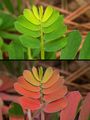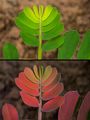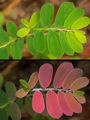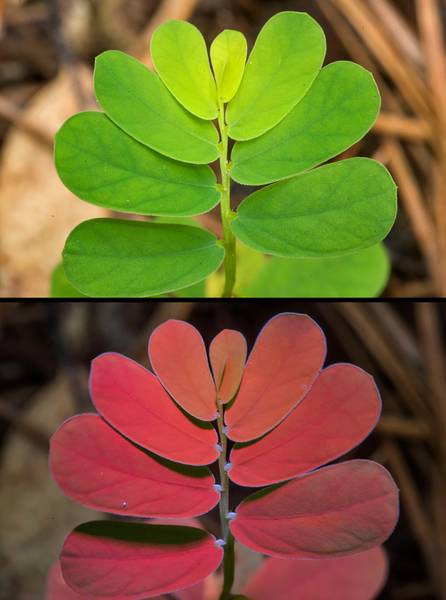

Close-up of leaves of leaf-flower plant Phyllanthus niruri when exposed to regular daylight as well as when illuminated by a 365 nm ultraviolet (UV-A) blacklight near Pole Creek on North Wilderness Trail of Little Lake Creek Wilderness in Sam Houston National Forest north from Montgomery. Texas


Album 3612: Sam Houston Forest, Texas, August 31, 2024
The image presents a comparative analysis of the leaf-flower plant Phyllanthus niruri under two distinct lighting conditions: regular daylight and illumination by a 365 nm ultraviolet (UV-A) blacklight.
**Upper Image**
* The upper image showcases the leaves in their natural state, illuminated by regular daylight.
* The leaves exhibit a vibrant green color with no visible signs of fluorescence or unusual pigmentation when exposed to normal light levels.
* The lighting conditions are typical of those found outdoors during daytime hours, providing a baseline for comparison with the effects of UV-A illumination.
**Lower Image**
* In contrast, the lower image depicts the same plant, but this time illuminated by a 365 nm ultraviolet (UV-A) blacklight near Pole Creek on North Wilderness Trail of Little Lake Creek Wilderness in Sam Houston National Forest north from Montgomery, Texas.
* Under these specialized lighting conditions, the leaves display an intense red coloration, indicating that they are capable of fluorescing in response to UV-A radiation.
* This phenomenon is known as photoluminescence or bioluminescence and is a characteristic feature of certain plant species.
**Comparison**
* A comparison between the two images reveals a striking difference in leaf coloration, with the UV-A illuminated leaves exhibiting a pronounced red fluorescence not visible under regular daylight conditions.
* This suggests that Phyllanthus niruri has evolved mechanisms to respond to specific wavelengths of light, potentially playing a role in its survival and reproduction strategies.
**Conclusion**
The image effectively highlights the unique ability of Phyllanthus niruri to fluoresce in response to UV-A radiation. This phenomenon underscores the complex interactions between plants and their environment, emphasizing the importance of considering multiple factors when studying plant biology. – AI vision
🇪🇸 Descripción en español / Spanish Description
El detalle de las hojas de la planta con flores Phyllanthus niruri cuando se exponen a la luz diurna habitual y también cuando se iluminan con una luz negra ultravioleta (UV-A) de 365 nm cerca de Pole Creek en el Sendero de Wilderness Norte de Little Lake Creek Wilderness en Sam Houston National Forest al norte de Montgomery. Texas, el 31 de agosto de 2024. La imagen presenta un análisis comparativo de la planta con flores Phyllanthus niruri bajo dos condiciones de iluminación distintas: luz diurna habitual e iluminación con una luz negra ultravioleta (UV-A) de 365 nm.
**Imagen superior** *La imagen superior muestra las hojas en su estado natural, iluminadas por la luz diurna habitual.* *Las hojas presentan un vibrante color verde sin signos visibles de fluorescencia ni pigmentación inusual cuando se exponen a niveles normales de luz.* *Las condiciones de iluminación son típicas de las encontradas al aire libre durante el día, proporcionando una línea base para la comparación con los efectos de la iluminación UV-A.*
**Imagen inferior** *En contraste, la imagen inferior representa la misma planta, pero esta vez iluminada por una luz negra ultravioleta (UV-A) de 365 nm cerca de Pole Creek en el Sendero de Wilderness Norte de Little Lake Creek Wilderness en Sam Houston National Forest al norte de Montgomery, Texas.* *En estas condiciones especiales de iluminación, las hojas presentan una intenso coloración roja, lo que indica que son capaces de fluorescer en respuesta a la radiación UV-A.* *Este fenómeno se conoce como fotoluminiscencia o bioluminiscencia y es una característica distintiva de ciertas especies vegetales.*
**Comparación** *Una comparación entre las dos imágenes revela una diferencia notable en la coloración de las hojas, con las iluminadas con radiación UV-A exhibiendo una pronunciada fluorescencia roja no visible bajo condiciones de luz diurna habitual.* *Esto sugiere que Phyllanthus niruri ha desarrollado mecanismos para responder a longitudes de onda específicas de la luz, lo que podría desempeñar un papel en sus estrategias de supervivencia y reproducción.*
**Conclusión** La imagen destaca efectivamente la capacidad única de Phyllanthus niruri para fluorescer en respuesta a radiación UV-A. Este fenómeno subraya las complejas interacciones entre las plantas y su entorno, lo que enfatiza la importancia de considerar múltiples factores al estudiar la biología vegetal.*. – Spanish translation