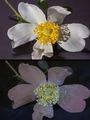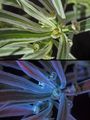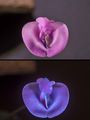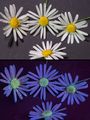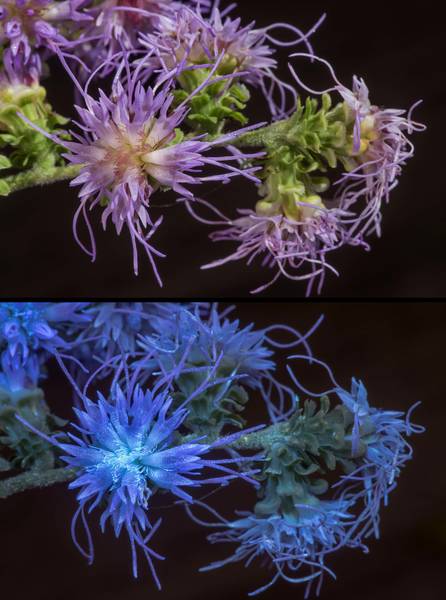

Gayfeather (Liatris bracteata(?)) when exposed to regular daylight as well as when illuminated by a 365 nm ultraviolet (UV-A) blacklight collected on North Wilderness Trail of Little Lake Creek Wilderness in Sam Houston National Forest north from Montgomery. Texas


Album 3612: Sam Houston Forest, Texas, August 31, 2024
The image presents a striking comparison between two photographs of Gayfeather flowers (Liatris bracteata(?)), captured under different lighting conditions: regular daylight and ultraviolet (UV-A) blacklight illumination.
**Image Description**
* The top photograph showcases the flowers' natural appearance in daylight, with purple petals and green stems.
* The bottom photograph reveals a dramatic transformation when illuminated by UV-A blacklight, where the flowers exhibit an intense blue-purple glow.
* The contrast between the two images highlights the unique response of Gayfeather flowers to different wavelengths of light.
**Visual Analysis**
* In the top image, the flowers appear relatively subdued, with their purple coloration not standing out significantly against the surrounding foliage.
* In contrast, the bottom image demonstrates a significant intensification of color, with the blue-purple hue dominating the visual landscape.
* The use of UV-A blacklight has accentuated the flower's natural pigmentation, resulting in a more vibrant and attention-grabbing appearance.
**Conclusion**
The image effectively illustrates the impact of UV-A blacklight on the appearance of Gayfeather flowers. By comparing the two photographs, it becomes clear that this type of light can significantly enhance the visual appeal of these plants, making them more noticeable and striking to observers. – AI vision
🇪🇸 Descripción en español / Spanish Description
La Gayfeather (Liatris bracteata(?)) cuando se expone a la luz del día normal y también cuando se ilumina con una lámpara negra de ultravioleta (UV-A) de 365 nm recogida en el North Wilderness Trail de Little Lake Creek Wilderness en Sam Houston National Forest al norte de Montgomery, Texas, el 31 de agosto de 2024. La imagen presenta una comparación sorprendente entre dos fotografías de flores de Gayfeather (Liatris bracteata(?)), capturadas en diferentes condiciones de iluminación: luz del día regular e iluminación con lámpara negra ultravioleta (UV-A). **Descripción visual** * La fotografía superior muestra las flores tal como son a la luz del día, con pétalos morados y tallos verdes. * La fotografía inferior revela una transformación espectacular cuando se ilumina con UV-A negra, donde las flores exhiben un intenso brillo morado azulado. * El contraste entre las dos imágenes destaca la respuesta única de las flores Gayfeather a diferentes longitudes de onda de luz. **Análisis visual** * En la imagen superior, las flores parecen relativamente discretas, con su coloración morada no destacando significativamente contra el paisaje circundante de hojas verdes. * Por el contrario, la imagen inferior muestra una intensificación significativa del color, donde el tono azul-morado domina el paisaje visual. * El uso de luz negra UV-A ha acentuado la pigmentación natural de las flores, dándoles un aspecto más vibrante y atractivo. **Conclusión** La imagen ilustra efectivamente el impacto de la luz negra UV-A en el aspecto de las flores de Gayfeather. Al comparar las dos fotografías, queda claro que este tipo de luz puede mejorar significativamente el atractivo visual de estas plantas, haciéndolas más notables y llamativas para los observadores. – Spanish translation