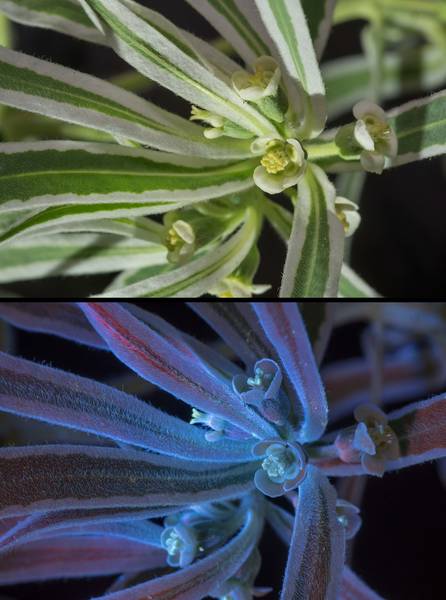

Snow-on-the-prairie (Euphorbia bicolor) when exposed to regular daylight as well as when illuminated by a 365 nm ultraviolet (UV-A) blacklight collected on North Wilderness Trail of Little Lake Creek Wilderness in Sam Houston National Forest north from Montgomery. Texas


Album 3612: Sam Houston Forest, Texas, August 31, 2024
The image presents two photographs of Snow-on-the-prairie plants, captured under different lighting conditions.
**Top Photograph: Daylight Exposure**
* The plant's leaves and stems display a green color with white stripes.
* Small, yellowish flowers are visible among the leaves.
* The background is dark, suggesting that the photograph was taken in low-light conditions or at night.
**Bottom Photograph: Ultraviolet (UV-A) Blacklight Exposure**
* The same Snow-on-the-prairie plant is now illuminated by a 365 nm UV-A blacklight.
* The colors of the leaves and stems appear more vibrant, with shades of blue and purple visible.
* The yellowish flowers have become more prominent, appearing as bright yellow or orange in color.
* The background remains dark.
**Comparison**
The two photographs demonstrate how different lighting conditions can affect the appearance of plants. While daylight exposure reveals subtle colors and details, UV-A blacklight illumination enhances the plant's natural pigments, making its features more visible. This comparison highlights the importance of considering various lighting conditions when observing or photographing plants. – AI vision
🇪🇸 Descripción en español / Spanish Description
Snow-on-the-prairie (Euphorbia bicolor) al exponerse a la luz diurna regular, así como cuando se ilumina con una luz negra ultravioleta de 365 nm recogida en el North Wilderness Trail del Little Lake Creek Wilderness en Sam Houston National Forest al norte de Montgomery. Texas, agosto 31, 2024. La imagen presenta dos fotografías de plantas Snow-on-the-prairie, capturadas bajo diferentes condiciones de iluminación.
**Fotografía superior: Exposición a la luz diurna**
* Las hojas y tallos de la planta muestran un color verde con rayas blancas.
* Son visibles flores amarillentas entre las hojas.
* El fondo es oscuro, lo que sugiere que la fotografía se tomó en condiciones de poca luz o de noche.
**Fotografía inferior: Exposición a una luz negra ultravioleta (UV-A)**
* La misma planta Snow-on-the-prairie está iluminada con una luz negra UV-A de 365 nm.
* Los colores de las hojas y tallos parecen más vibrantes, con tonalidades de azul y morado visibles.
* Las flores amarillentas son más prominentes, apareciendo en color amarillo o naranja brillante.
* El fondo sigue siendo oscuro.
**Comparación**
Las dos fotografías demuestran cómo diferentes condiciones de iluminación pueden afectar la apariencia de las plantas. Mientras que la exposición a la luz diurna revela colores y detalles sutiles, la iluminación con luz negra UV-A potencia los pigmentos naturales de la planta, haciendo que sus características sean más visibles. Esta comparación subraya la importancia de tener en cuenta diferentes condiciones de iluminación al observar o fotografiar plantas. – Spanish translation