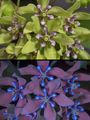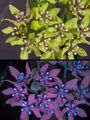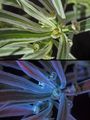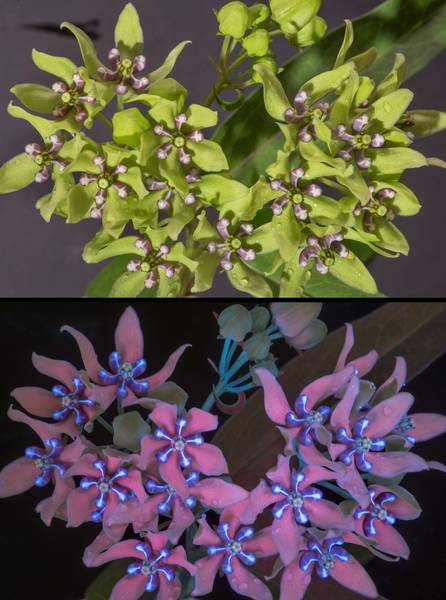

Flowers of green milkweed (Asclepias viridis) when exposed to regular daylight as well as when illuminated by a 365 nm ultraviolet (UV-A) blacklight collected on North Wilderness Trail of Little Lake Creek Wilderness in Sam Houston National Forest north from Montgomery. Texas


Album 3612: Sam Houston Forest, Texas, August 31, 2024
The image features two photographs of green milkweed (Asclepias viridis) flowers, showcasing their appearance under different lighting conditions.
**Photograph 1: Daylight**
* The top photograph depicts the flowers exposed to regular daylight.
* The petals are a vibrant green color with small purple tips.
* The background is dark, suggesting that the image was taken in a shaded area or at night.
**Photograph 2: Ultraviolet (UV-A) Blacklight**
* The bottom photograph shows the same flowers illuminated by a 365 nm ultraviolet (UV-A) blacklight.
* Under UV light, the petals exhibit a striking blue coloration, while the background remains dark.
* This suggests that the UV light has caused the plant's natural fluorescence to be visible.
**Overall Observation**
The image highlights the unique properties of green milkweed flowers when exposed to different lighting conditions. The use of UV-A blacklight reveals a hidden aspect of the plant's biology, demonstrating its ability to fluoresce under specific wavelengths of light. This phenomenon could have implications for our understanding of plant behavior and ecology.
**Summary**
In summary, the image presents a fascinating comparison between green milkweed flowers under daylight and UV-A blacklight conditions. The photographs showcase the plant's unique response to different lighting environments, revealing its ability to fluoresce under specific wavelengths of light. This observation has potential applications in fields such as botany, ecology, and conservation biology. – AI vision
🇪🇸 Descripción en español / Spanish Description
Las flores de lechetrezna verde (Asclepias viridis) cuando se exponen a la luz del día normal, así como también cuando se iluminan con una luz negra ultravioleta (UV-A) de 365 nm recolectada en el North Wilderness Trail of Little Lake Creek Wilderness en Sam Houston National Forest al norte de Montgomery, Texas, el 31 de agosto de 2024. La imagen muestra dos fotografías de las flores de lechetrezna verde (Asclepias viridis), mostrando su apariencia bajo diferentes condiciones de iluminación. **Fotografía 1: Luz del Día** * La fotografía superior representa las flores expuestas a la luz del día normal. * Los pétalos son de un verde vibrante con pequeñas puntas moradas. * El fondo es oscuro, lo que sugiere que la imagen fue tomada en una área sombreada o de noche. **Fotografía 2: Luz Negra ultravioleta (UV-A)** * La fotografía inferior muestra las mismas flores iluminadas con una luz negra ultravioleta (UV-A) de 365 nm. * Bajo la luz UV, los pétalos exhiben un llamativo color azul, mientras que el fondo sigue siendo oscuro. * Esto sugiere que la luz UV ha causado que sea visible la fluorescencia natural de la planta. **Observación General** La imagen destaca las propiedades únicas de las flores de lechetrezna verde cuando se exponen a diferentes condiciones de iluminación. El uso de luz negra ultravioleta (UV-A) revela un aspecto oculto de la biología de la planta, demostrando su capacidad para fluorescer bajo longitudes de onda específicas de la luz. Este fenómeno podría tener implicaciones para nuestra comprensión del comportamiento y ecología de las plantas. **Resumen** En resumen, la imagen presenta una comparación fascinante entre flores de lechetrezna verde bajo condiciones de luz del día y UV-A negra. Las fotografías muestran la respuesta única de la planta a diferentes entornos de iluminación, revelando su capacidad para fluorescer bajo longitudes de onda específicas de la luz. Esta observación tiene potenciales aplicaciones en campos como botánica, ecología y conservación de la biología. – Spanish translation